How the Female Psyche Built Homes
“A book is not made of sentences laid end to end, but of sentences built, if an image helps, into arcades or domes” ~ Virginia Woolf, A Room of One’s Own
Darkness. Terror. Pain. Death.
The Gothic.
Throughout the late 18th to the early 19th Century, Britain underwent a Gothic craze. From literature to architecture, nothing could escape its influence.
The Gothic, as summarised by Dr. Rebecca Marks, is ‘the opposite of ‘Classical’. Classical is ordered, harmonious, and rectilinear. Gothic is chaotic, discordant, and curvilinear.’
Early in the Gothic Revival, men viewed Gothic literature as a ‘female genre’. Women were derogatively believed to be prone to the imagination and flights of fancy, both of which were hallmarks of the genre. Women reflected the chaos and discord of the Gothic, while men embodied the order and harmony of the ‘Classical’.
Undoubtedly, women were attracted to Gothic literature, with approximately 70% of the authors and readership in the Georgian era being female. Unlike men, women found liberation in the tropes of the Gothic and solace in the self-expression it afforded.
Men did, however, find value in Gothic architecture, and the architectural Gothic Revivalist movement was heavily associated with men. An early example is the work of Horace Walpole. Not only was Walpole the author of the classic Gothic work, The Castle of Otranto, but he also designed Strawberry Hill, which is considered a prototype of the Gothic Revivalist architecture. However, throughout this period, women also conveyed their own life stories, not only through words but through their architectural design.
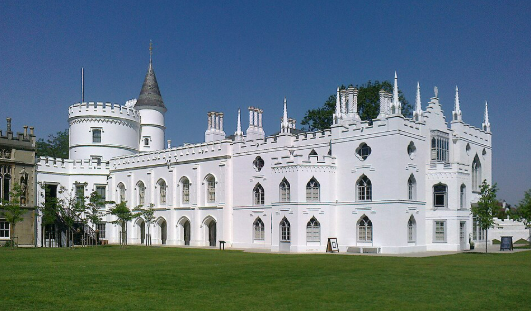
Strawberry Hill House in 2012.
Gaining Power
As explored in Theatre of the Past III: Domesticity and Femininity, girls of upper- and middle-class status were expected to be accomplished in drawing and painting, art being a focus point of their education.
Some girls discovered it was possible to take advantage of this emphasis on the arts by incorporating the traditionally male subjects of architectural drawing, surveying and draughtsmanship into their education. Once women gained an understanding of architectural design, they could use it to communicate their own stories and enter into a dialogue with their sometime enemy: The Home.
In the literary genre now termed the ‘Female Gothic’, women authors used the genre’s conventions to rail against the constraints of a society which had turned the home into a prison and the role of wife and mother into a saintly façade. As women ventured into the architectural Gothic revivalist movement, they communicated their rage, their terror and their resilience through bricks and mortar.
Upon the Death of Bluebeard
In Angela Carter’s short story, The Bloody Chamber, a feminist reinterpretation of the French fairytale Bluebeard (La Barbe Bleue), the Marquis is defeated and the young female protagonist inherits his castle and transforms it into a school for the blind. A similar reclaiming of space is seen across Georgian female architecture, an early example being the work of Henrietta, Dowager Countess of Oxford and Mortimer. Upon the death of her husband, Lady Henrietta sold her marital home and returned to the seat of her maternal ancestors, Welbeck Abbey in Nottinghamshire. There, Lady Henrietta embodied the spirit of the Female Gothic and transformed the run-down property, remodelling the building with features from the early Gothic Revival movement.
When she was widowed, Lady Henrietta was in financial ruins due to her husband’s extensive debts. Reinstalled at Welbeck Abbey, she designed spaces such as the Gothic Hall and Staircase to reflect an eccentric sense of ornate grandeur. Rich dark panelling and an intricate fan vaulted ceiling are just two features that express the asymmetry, chaos and disruption of her own experience that mirror the Gothic. But, despite the intricacy of the spaces Henrietta designed for hosting friends, nothing was more sacred than her ‘Gothic Closet’ – a private retreat just for her. Here, she fulfilled Virginia Woolf’s manifesto of feminism: a room of one’s own. This space fully embodied Lady Henrietta’s reclaiming of her ancient maternal lineage and celebrated her autonomy within a patriarchal society.
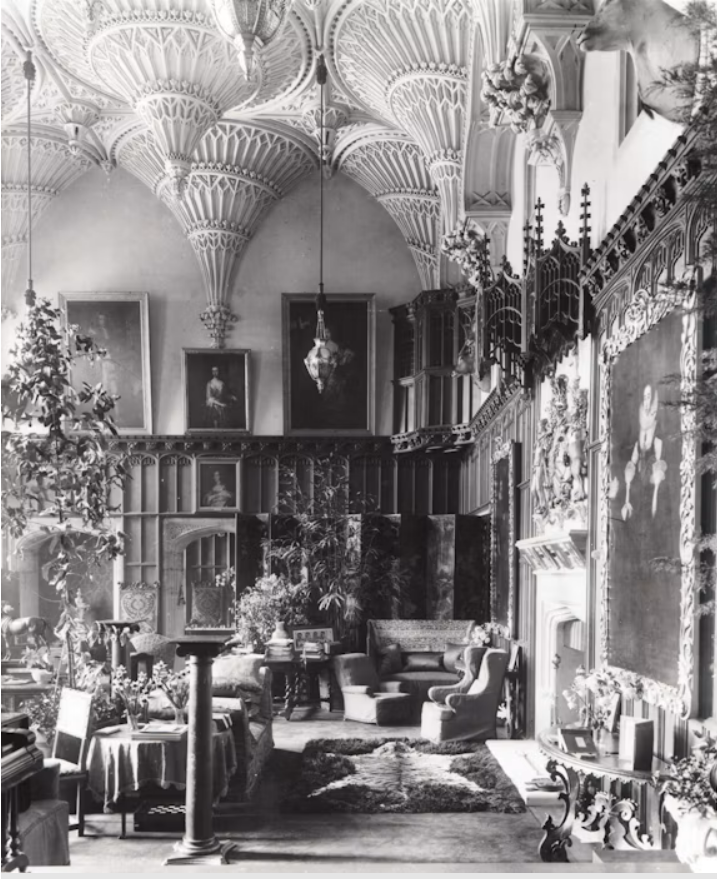
The Gothic Hall, Welbeck Abbey in 1906. This photograph clearly details the panelling and fan-vaulted ceiling.
A La Ronde: re-writing the story
In Devon, there stands A La Ronde. A La Ronde was the sixteen-sided home of two cousins, Jane and Mary Parminter. After returning to England from a long tour abroad, Jane took to architectural design, taking inspiration from nature to create a home that is a testament to the Gothic rebellion against female suppression. In a world of classical architecture, where its clean symmetry and geometric shapes symbolised masculine harmony and conformity, A La Ronde stood out as a defiantly feminine, quirky, kaleidoscopic building.
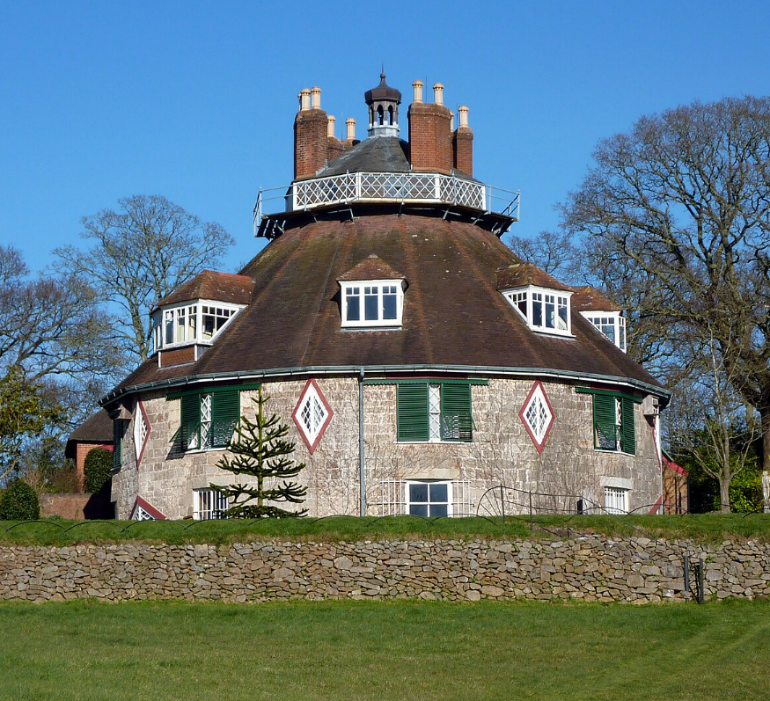
The exterior of A La Ronde.
The interior design was centred around an octagonal hall with a series of interconnecting doors, which meant that the cousins only required the assistance of a small all-female staff. The rooms were designed to follow the pattern of the sun according to their function, with the bedrooms catching the first rays of morning light and the by evening the drawing room illuminated by the final rays of the dying sun. The structure reveals the cousins’ embracing of their own circadian rhythms and biological cycles. One of A La Ronde’s most spectacular features, the Shell Gallery, where the walls are encrusted by a vast collection of shells, bird feathers, minerals and bone fragments, is a moving tribute to the Gothic: against the backdrop of daylight, there is decay.
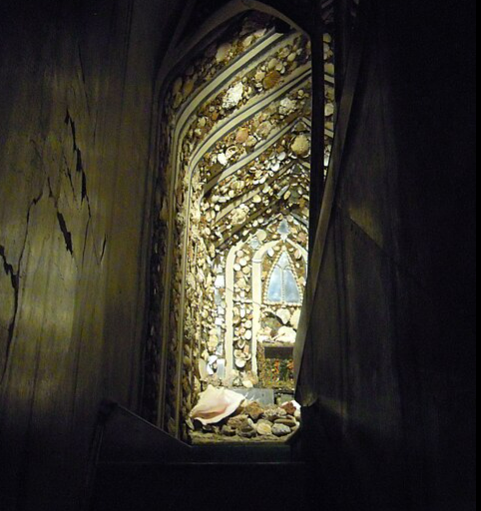
The entrance to the Shell Gallery at A La Ronde
Throughout the Georgian era, the classical style of architecture aimed to reflect the male assertion of power. But the contribution of women to architecture demonstrated how raw female instinct could be a powerful weapon in the face of patriarchy. Much like in the Female Gothic, the home, as the symbol of female oppression, is transformed into a realm of victorious survival and self-expression. Welbeck Abbey stood strong as a testament to a successive female heritage. A La Ronde was a house that celebrated the wild forces of nature and feminine energy, transforming the home from a prison into a living organism. And, in the 1850s, Strawberry Hill, the early site of male exploration of the Gothic Revivalist movement, was restored and extended by a woman, Lady Frances Waldergrave.
Does your home contain features of the Gothic Revivalist movement? If you were to explore the architecture of your home, what story would it tell?
Our journal, Built to Last, asks the question ‘What does it mean to be a good custodian?’ Through essays, conversations and stories rooted in real buildings and the people who care for them, we explore what it takes to preserve an old home’s fabric and its story - and the decisions that shape both.
At Pursuing the Past, we research and write beautifully presented House Stories, turning historical detail into lasting pieces of storytelling that deepen your connection to your home and invite you to take your place as custodian of its continuing story.