From the familiar to the radical
“It is a noble ideal to be a great scholar, but it is a far nobler one to be a helpful and loving daughter, sister, or wife.” ~ Barbara Foxley, 1886
In the 19th Century, the expectation for a girl of the middle and upper classes was that their education should be sufficient to equip them to be a wife, mother and home-keeper. Academic education ceased at the age of ten to be replaced by accomplishments, such as conversational French and needlework, with training in running a household beginning at fourteen. For most girls, this at-home tutoring was provided by a governess but, as the middle classes expanded throughout the industrial revolution, many middle-class families chose to send their daughters away to boarding school. What began as a small movement expanded throughout the century as advancements to girls’ education were made, and at the centre of these advancements was the Victorian house.
Roe Head School in Mirfield, West Yorkshire, was an early example of a female boarding school. The three Bronte sisters, Charlotte, Emily and Anne, were counted among the pupils. Like many families of the professional middle class, Patrick Bronte was unable to afford a governess to educate his daughters, so he chose to send them away to school for a few years of formal education. Roe Head was a country home before it was converted into a school in 1830 by Miss Margaret Wooler. Most girls arrived at the school around the age of fourteen and stayed until they turned eighteen. Their education comprised basic academics in the morning, i.e. English grammar and simple numeracy, and accomplishments including painting, French and embroidery in the afternoons. The emphasis in girls’ boarding schools, as it was across society, was placed on preparing girls for life in the drawing room.
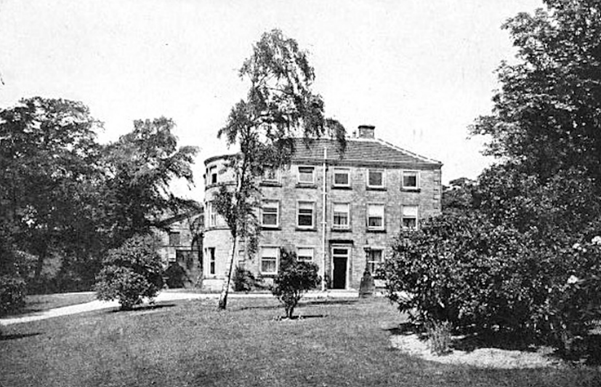
Roe Head School, Mirfield, West Yorkshire
Unlike a boy’s education, where deliberate separation from the family home was considered vital to their development, there was no desire for girls to be psychologically distant from the concept of ‘home’. Maintaining a feminine and domestic identity was viewed as crucial in a girl’s education. Almost all schools were hosted in small domestic buildings, with pupil numbers averaging between ten and twenty to mimic a family environment. The interiors of these houses were also intended to reflect the comforts of an upper-middle class home; girls would have embroidery lessons in lavishly furnished sitting rooms, and they were encouraged to design the dining room with white tablecloths, formal cutlery and floral arrangements. Sometimes, the show of domesticity ended with these rooms and draughty classrooms and packed dormitories where children slept two-a-bed were a stark, behind-the-scenes reality. In other institutions a handful of plain but comfortable bedrooms were shared by two girls to each room.
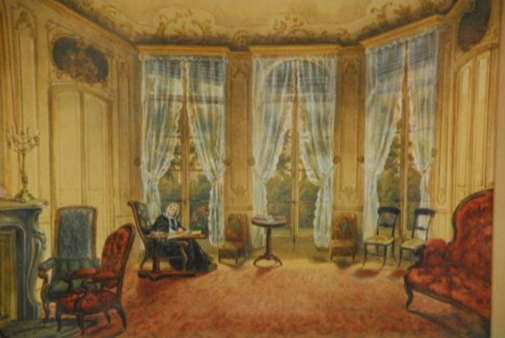
Drawing Room in a girls’ boarding school, where lessons in embroidery would have taken place
The attitude towards girls’ boarding schools as moulding the next generation of gentile housewives continued well into the early 20th Century; the writer Lucy Boston described her education in the 1890s as:
‘…the bulk of the class seemed simply to sit through every lesson without the slightest interest or effort… This attitude continued right through the school. None of these girls was going to earn her own living. There was no pressure at all, no Eleven plus, no ‘O’ or ‘A’ level. They saw no point in learning. They were there to be kept out of mischief till they grew up.’
The Victorian villa as a boarding school was used to the advantage of female educators who hoped to advance girls’ academic progress. Many women involved in the women’s suffrage realised the powerful role of schools in grooming women to become the ‘Angel of the House’ and recognised that the same academic institutions could be used to emancipate women. One suffragette in particular, Elizabeth Wolstenholme Elmy, set about to bring change to girls’ education. At the age of twenty-one, she inherited a sum of money which she invested in a small residential property, The Grange on Boothstown Road, Salford. She converted the property into a boarding school for middle class girls.
From the outside, the school appeared to be the same as every other Young Ladies’ establishment: comfortable furnishings and a small cohort of fourteen pupils who were taught according to the daily curriculum of subjects such as dancing, singing and fine drawing. But privately Elizabeth was preparing her pupils for a life outside of the home. Alongside basic numeracy and literacy, the girls were taught mathematics, sciences and politics, skills which were believed at the time to be incomprehensible to the delicate female nature. Elizabeth prepared her pupils so well that they were able to sit and pass the Cambridge Local Examination, which began to open the world of higher education to women.
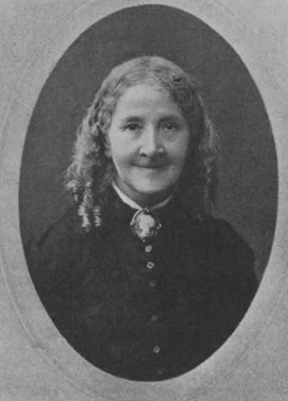
Elizabeth Wolstenholme Elmy
The Victorian villa was the perfect architectural choice for the development of girls’ education. Internally, Victorians homes were designed to maintain a strict sense of hierarchy, which not only provided the opportunity for private sitting rooms to be converted into classrooms and former servants’ quarters to be turned into dormitories but enforced a sense of hierarchy between pupils and staff.
The domestic space of a Victorian villa also allowed for the illusion of ‘the home’ to be maintained and for a traditional ‘accomplishment’ based education to take place: the existing dining room could be facilitated for teaching etiquette, and the drawing room could be used for piano and painting lessons. The restricted floorspace of a house also restricted pupil numbers, creating a family atmosphere within the school.
As Victorian villas were typically detached houses purposely designed to be insular with high brick walls, female pupils could be kept isolated and sheltered from the ‘harmful influences’ of public life, which was prized in the Victorian era. This insularity was quickly weaponised by women looking to advance female education, allowing Elizabeth Wolstenholme Elmy and her pupils to hide behind the gentile smokescreen of a Victorian villa, validating female intellectual ability and advancing the case for women to have the right to vote.
Our journal, Built to Last, asks the question ‘What does it mean to be a good custodian?’ Through essays, conversations and stories rooted in real buildings and the people who care for them, we explore what it takes to preserve an old home’s fabric and its story - and the decisions that shape both.
At Pursuing the Past, we research and write beautifully presented House Stories, turning historical detail into lasting pieces of storytelling that deepen your connection to your home and invite you to take your place as custodian of its continuing story.