Religious Relics
The dead of night. Thomas and Mary Habingdon are sleeping soundly. An almighty crash! The stamping of boots and yelling. Thomas and Mary are seized roughly from their beds and, shivering in only night attire and bare feet, are led to the central hall, clutching each other desperately. Hindlip Hall is surrounded by one hundred men who trample around the Hall, armed with axes. All Thomas and Mary can hear is the sound of splintering wood as the men hack their way through the floorboards, ceilings and fireplaces. Then silence. Only the hammering of hearts in chests and breaths escaping lungs in shallow gasps.
This is England, 20 January 1606. The most famous priest-hunter raid in history.
Hindlip Hall in Worcestershire was notorious for its role in the failed Gunpowder Plot of 1606. Designed and owned by Catholic recusant John Habingdon, Hindlip Hall had one of England’s most extensive collections of priest holes. A total of eleven hides was designed by the Jesuit builder, Nicholas Owen. Among Hindlip Hall’s most intricately designed hides was a hidden trapdoor built into the chimney breast which led to a compartment running parallel to the smoke shaft.
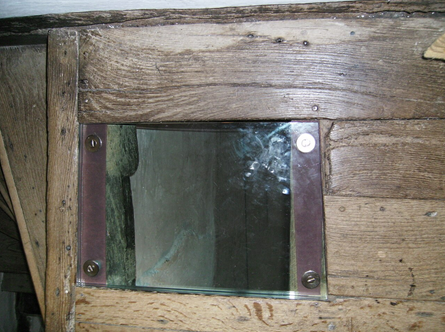
Image: A Priest Hole at Boscobel House, Shropshire
In 1584, during the dark aftermath of the Reformation, Elizabeth I introduced the Act against Jesuits, which established that all Catholic priests would have to leave England, and anyone caught harbouring them would be fined and imprisoned or potentially even executed for committing treason.
In a loyal expression of faith, many Catholic families defied government orders and allowed the remaining priests to shelter in their homes. After all, it was only through a Priest that a practising Catholic could receive the sacraments of Holy Mass, Confession, and Last Rites.
At a Jesuit conference held in 1586, the decision was made to smuggle priests into country houses, in which would be installed a specially designed hide, known as a priest hole. Agents of the English government, known as ‘Priest Hunters’ or pursuivants, attempted to capture any Catholic Priests hidden in country houses across England through a series of violent raids.
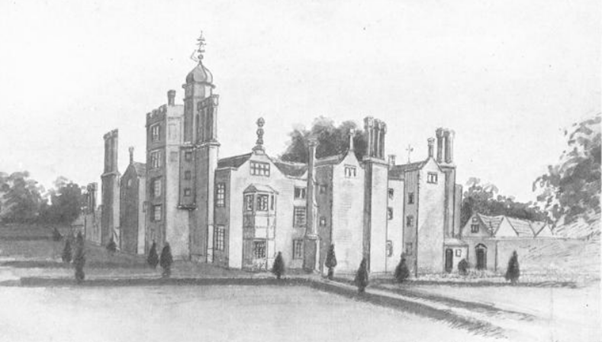
Image: The original Hindlip Hall
After the failure of the Gunpowder Plot on 5th November 1605, two priests who had been involved fled to Hindlip Hall, where they hid alongside Nicholas Owen and his apprentice. On 20th January, when the army of pursuivants surrounded Hindlip Hall and began an intensive, twelve-day police raid, all four of the hidden men were forced to surrender, suffering from starvation and exhaustion. They were eventually tortured and executed. The then estate owner, Thomas Habingdon, was arrested but ultimately spared execution on the promise that he would never return to Worcestershire and Hindlip Hall again.
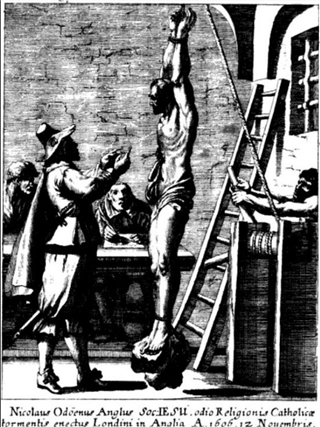
Image: The Torture of Nicholas Owen (canonised as St. Nicholas Owen)
While the original Hindlip Hall and its priest holes were destroyed in a fire in 1820, there are several other country homes across Britain that bear the scars of their fraught history.
Fifty-six years after the priest hunter raid on Hindlip Hall, a retinue landed at Portsmouth. It carried the Portuguese princess, Catherine of Braganza, the bride of Charles II. Among the retinue was a pageboy called Alvaro de Costa. Alvaro went on to purchase Cromwell House in 1675, the first Jewish-owned property in England since the expulsion of Jews in 1296.
Alvaro arrived in England as a ‘New Christian’ – a member of a family of Jewish origin who had converted to Catholicism – but by the late 1670s, amid strong anti-Catholic feeling in Britain, Alvaro began to express his Jewish faith openly. His home at Cromwell House, Highgate, stands as a testament to this.
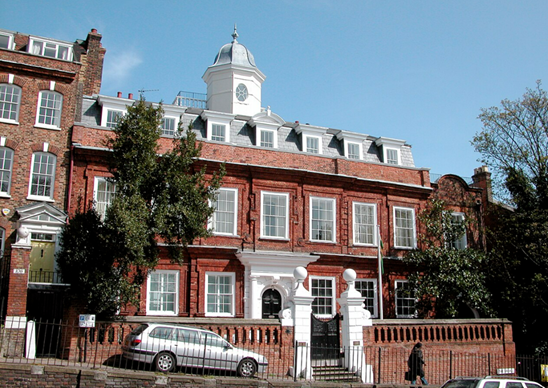
Image: Cromwell House as it looks today
Two-thirds of the way into a large ground floor room at Cromwell House lies a row of studs which have been hammered into the floor. These studs are believed to denote the presence of a mechitzah, a partition used to separate men and women of the Orthodox Jewish faith during prayers. This has led historians to believe that Alvaro hosted the small Jewish community of Highgate for regular synagogue services.
Historians have also noted abnormalities to the plumbing leading to the cellar, indicating that it once housed a Mikvah, a ritual immersion pool. The water that fills a Mikvah must come from a natural source, such as rainwater, which could explain the plumbing abnormalities. In Jewish custom, the construction of a Mikvah is prioritised over that of a synagogue; if Cromwell House contained a private synagogue, it would be logical to assume a Mikvah would also have been constructed.
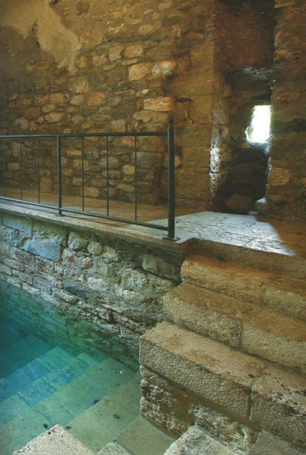
Image: A Medieval Mikvah in Spain
When heritage homes are inherited, many people are often eager to learn of the lives of former residents through traditional research, such as genealogical documents. But some of the hidden clues to previous residents’ stories can very literally be embedded in the walls of their homes. Discovering religious relics can tell you so much about the people who made these houses their home.
Priest holes sequestered into the woodwork symbolise defiance, the courage of people to stand up for what they believed in, even in the face of great adversity and even death. Architectural evidence of a Jewish presence at Cromwell House represents the conviction and confidence of a marginalised community, who, also in the face of discrimination, chose to live their faith boldly.
If your walls could talk, would they “echo with the tap-tap-tap of the pursuivant cane, listening for the telltale hollow knock?” (Harvington Hall)
Our journal, Built to Last, asks the question ‘What does it mean to be a good custodian?’ Through essays, conversations and stories rooted in real buildings and the people who care for them, we explore what it takes to preserve an old home’s fabric and its story - and the decisions that shape both.
At Pursuing the Past, we research and write beautifully presented House Stories, turning historical detail into lasting pieces of storytelling that deepen your connection to your home and invite you to take your place as custodian of its continuing story.