How the Great War signalled the Death Knell for the Home
Part I: August Madness
On 3rd August 1914, the sun set on the Edwardian era.
Edwardian life had been filled with the kind of gaiety and uninterrupted innocence that begets peace time. With the declaration of war in Britain fast approaching, Sir Edward Grey, the Foreign Secretary, lamented:
‘The lamps are going out all over Europe; they will not be lit again in our lifetime.’
Today, historians agree that the dramatic upheaval of the First World War shook Europe out of its complacency, with historian Edmund Taylor summarising:
“The First World War killed fewer victims than the Second World War... but in many ways it left even deeper scars both on the mind and on the map of Europe. The old world never recovered from the shock.”
The passing of the old world in exchange for the dawn of the new 20th century also signalled the death knell for the Edwardian sense of home. But in the summer of 1914, bathing in the sunlight of what would later be nicknamed ‘Europe’s Last Summer’, such dramatic change seemed unthinkable.
As explored in the Theatre of the Past series, throughout the Victorian period and extending into the Edwardian period the home was spiritualised as a sanctifying space encapsulated within the walls of a house; it represented protection, morality, domestic order and peacefulness. In Edwardian society, the fireplace or ‘hearth’ was the focal point of family life, symbolising domestic bliss. As Head of Household, the eldest male was responsible for guarding the dignity and honour of his home.
Emanating from this gendered, class-bound, hierarchical society were thousands of eager young men who willingly joined the Army in the summer and early autumn of 1914. They were swept along in the August Madness of marching army bands and the waving of flags, attracted by glittering uniforms and the heady promise of patriotism. Wartime propaganda capitalised on the domestic ideal to maintain morale in the early stages of the conflict.
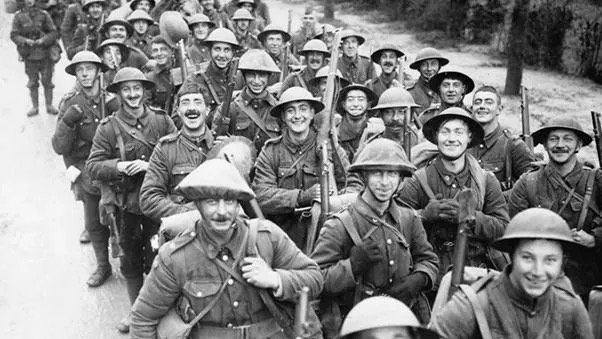
The War was romanticised as an act of chivalry and patriotism to protect the sacredness of the home. This spirit was captured in the poetry of the time. Rudyard Kipling’s For All We Have and Are, written in 1914, reflects the call-to-arms and the threat of loss of the old world:
‘For all we have and are,
For all our children’s fate,
Stand up and take the war.
The Hun is at the gate!
Our world has passed away,
In wantonness o’erthrown.
There is nothing left to-day
But steel and fire and stone!’
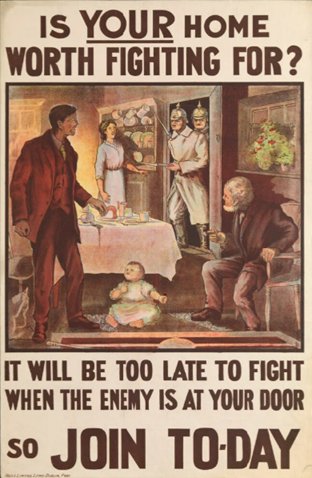
A First World War Poster using the image of the Edwardian Home as propaganda
Although in Edwardian Britain the male education system was designed to prepare boys for army life and long separations by creating a psychic and physical distance from the home, the reality of mechanised warfare intensified the idealisation of the home. For soldiers at the Front, knee deep in a mud-filled trench, the memory of home became emblematic of all that they missed: loved ones, peace and security. Siegfried Sassoon’s A Letter Home (1916) projects this idealistic, dreamlike vision; he escapes his daily surroundings by retreating to his innocence and youth as he reimagines his life back home:
“Where I wag my arms and hollo,
Over hedges hasting after
Crooked smile and baffling laughter,
Running tireless, floating, leaping,
Down your web-hung woods and valleys,
Where the glowworm stars are peeping…”
The women, who watched silently as their husbands, brothers and sons marched off to war, were fed a different kind of propaganda. Having been cast as the ‘Angel of the House’ for generations, songs were commissioned to keep a woman’s focus on the home, thereby raising the morale of those who were left behind. The role of ‘Angel of the House’ was always perceived as a spiritual anchor. It was a given that women would continue this role in wartime. The hearth, being central to the concept of domesticity with the wife at the forefront, was employed in the song Keep the Home Fires Burning which was commissioned in 1914 at the outbreak of the First World War as a propaganda device with specific lyrics to remind the women of their duty:
‘Let no tears add to their hardships
As the soldiers pass along,
And although your heart is breaking
Make it sing this cheery song
Keep the Home Fires Burning,
While your hearts are yearning,
Though your lads are far away
They dream of home.
There’s a silver lining
Through the dark clouds shining,
Turn the dark cloud inside out
‘Til the boys come home.’
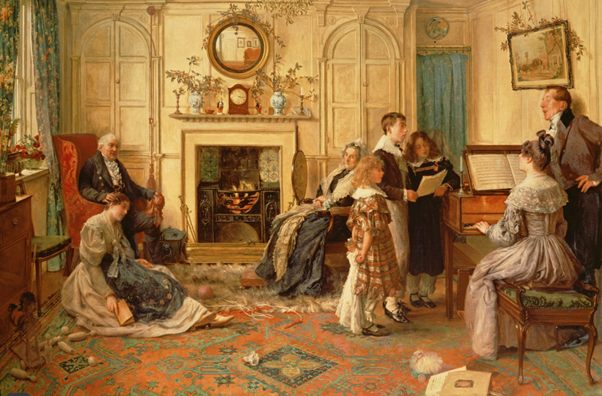
The quintessential image of the Edwardian Home, complete with a hearth
But this August Madness wasn’t to last. As the dark clouds of war cast a long shadow over Europe during the following years, the foundations of the Edwardian home were shaken irreparably. On the Home Front houses began to take on new roles, advancing the war effort by providing services for billeting, convalescence and ultimately memoriam. On the Front lines the home was turning slowly into a source of resentment. And through it all, poetry traced the demise of the old ideals into disillusionment:
‘Slowly our ghosts drag home: glimpsing the sunk fires, glozed
With crusted dark-red jewels; crickets jingle there;
For hours the innocent mice rejoice: the house is theirs;
Shutters and doors, all closed: on us the doors are closed,—
We turn back to our dying.’
Exposure, Wilfred Owen (1918)
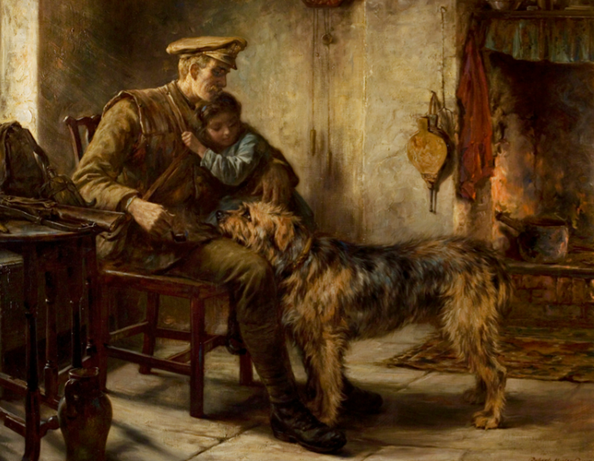
Home on Leave from France (1918) by Robert Morley. Copyright: Nuneaton Museum and Art Gallery
Our journal, Built to Last, asks the question ‘What does it mean to be a good custodian?’ Through essays, conversations and stories rooted in real buildings and the people who care for them, we explore what it takes to preserve an old home’s fabric and its story - and the decisions that shape both.
At Pursuing the Past, we research and write beautifully presented House Stories, turning historical detail into lasting pieces of storytelling that deepen your connection to your home and invite you to take your place as custodian of its continuing story.