The Home as a Fortress
‘Every home should be a fortress, equipped with all the very latest engines for keeping Nature at bay, versed in all ancient magic, the arts of quelling the Dark Lord and his hungry animivorous chimaeras.’ ~ W.H. Auden, The Common Life
From the seventeenth concept “A man’s home is his castle”, the house has served as a fortress: sheltering us from an often cruel and hostile outside world. This refuge takes on the most significance when who you are and what you stand for comes into conflict with an unforgiving society. These next two articles feature homes for whom their purpose of a refuge was central to the survival of their residents.
On the fringes of Bath, a glade of trees shade those beneath from the harsh glare of the sunlight. The women wandering this glade are among the most important figures to walk through history. But as so often happens to women, history has quietened their footsteps.
The Suffragette Movement (officially known as the Women’s Social and Political Union) was encapsulated by its powerful slogan ‘Deeds Not Words’. Founded in 1903 by Emmeline Pankhurst, the WSPU used militant tactics to advance the rights of women in society, in particular women’s right to the vote. Ten years into the movement, with little progress being made, the suffragettes turned to more drastic measures, such as vandalism which resulted in many arrests. Following imprisonment for their crimes, many suffragettes engaged in hunger strikes as a means of attracting attention to their campaign. Initially, these hunger strikes were met with force feedings. The public were shocked by the brutality and shocking mortality rates involved, many deaths being caused through the incorrect insertion of a feeding tube into the lungs, causing severe pneumonia.
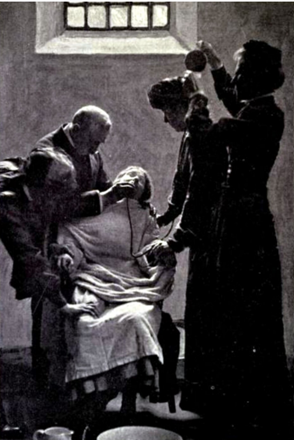
Image: a suffragette on a hunger strike being force-fed by a nasal tube
In response to the public outcry, the government introduced the Prisoners (Temporary Discharge for Ill-Health) Act 1913. The act determined that when a hunger strike began to impact upon a woman’s health, she would be permitted a temporary release from prison to recover before being rearrested and returned to prison to serve out the remainder of her sentence. This cycle of release and rearrest earned the Act the nickname “The Cat and Mouse Act”, as it paralleled a cat toying with its prey. Soon after the commission of the act, however, the game was reversed. The ‘Mice’ began to vanish, making it impossible for the ‘cat’ to retrieve them.
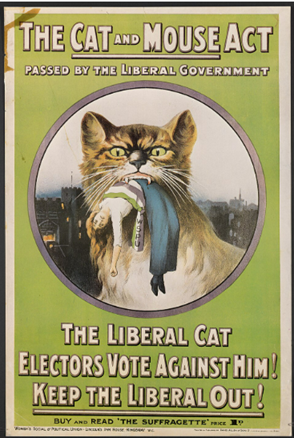
Image: a political poster protesting the 1913 Cat and Mouse Act
Town Mouse and Country Mouse
Anyone familiar with the 1940s short films Tom and Jerry will be able to understand what happened next in the game of cat and mouse. Upon release, the ‘mice’ were escorted to a house of their choosing by the police. From that point on, the suffragette was under house arrest until she was well enough to return to prison. She would be watched all day and night by detectives. But the presence of a cat wasn’t going to deter these mice. The suffragettes began operating a network of safe houses in middle class urban areas across the country. A famous safe house was 2 Camden Hill Square in Kensington, London. Owned by prominent suffragette, Marie Brackenbury, 2 Camden Hill Square became known as ‘Mouse Castle’. Mouse Castle was a mousehole: a protective shelter which allowed a suffragette to rest, break her hunger strike and receive medical assistance from a trusted doctor.

Image: Mouse Castle, 2 Camden Hill Square, Kensington
But, as nature teaches us, the burrows of wild mice have multiple entrances and exits. In the early hours of the morning, when the supernatural is at its height, the light, scampering footsteps of the mice often outran the slumbering cat. At other times, in a cartoonish effort worthy of Tom and Jerry, a wiry errand boy in a flat cap might leave Mouse Castle, followed by the shuffling steps of a wizened, elderly lady. Only when these characters were a train journey away might the cat suddenly awake to the realisation that it had lost its prey.
The newly escaped ‘town mice’ would be able to find sanctuary in safe homes created for ‘country mice’. Among the country homes opened to the suffragettes by supporters, Eagle House was particularly treasured.
Opened up for use by the suffragettes in 1909 by the Blathwayt family after the women in the family, Emily Blathwayt and her daughter Mary, began to support the movement, this country house and others like it were chosen to promote long term convalescence among those women who had been severely weakened and traumatised while in prison. These houses also offered a secluded place to hide: attic spaces and outbuildings like summerhouses were reserved for evading re-arrest.
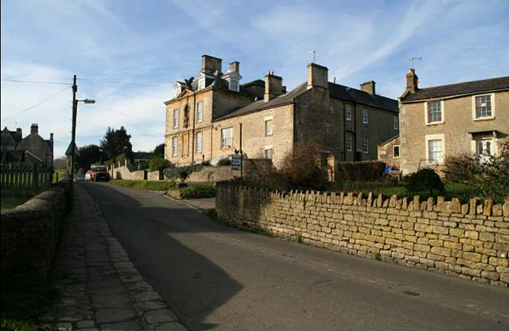
Image: Eagle House in 2010
It was in such an atmosphere of exhaustion, heightened tension and broken spirits that the idea of Annie’s Arboretum was born. Emily Blathwayt conceived of the idea of a woodland retreat for the suffragette women based on the Edwardian concept of botanical spaces providing physical and spiritual renewal. Annie’s Arboretum in the grounds of Eagle House was named after suffragette Annie Kennedy, who had the honour of planting the first tree. Each suffragette who resided at Eagle House (nicknamed ‘Suffragette’s Rest’) was invited to plant a tree. The trees denoted the different contributions made by each of the women:
Holly trees, symbolising endurance and devotion, were planted by suffragettes who had engaged in non-violent activism, while suffragettes who had survived imprisonment and were recovering from hunger strikes and force feeding were invited to plant the strong and unyielding conifer in commemoration of their bravery.
The trees were each marked by a plaque recording the date and name of the suffragette who planted them. Over the years, the arboretum expanded into what was hoped to be an everlasting testament to their sacrifice.
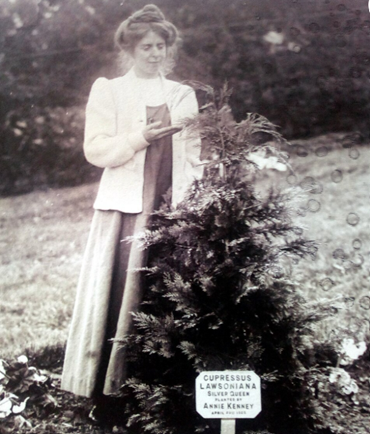
Image: Annie Kennedy planting the first tree in what would become known as Annie’s Arboretum
While many of the homes used as suffragette safe houses cannot be identified by anything as remarkable as an arboretum, it is possible that your heritage home was one in the network of safe houses that provided refuge to the suffragettes. Those who ran safe houses often found their names making their way to biographies or activist rolls. These brave ‘mice’ left behind a paper trail for a present-day resident to trace.
In a final twist of irony, Annie’s Arboretum was destroyed in the 1960s, being cleared to pave the way for a housing development. So, while Annie’s Arboretum is lost to us, the spirit of these women isn’t, and by following their trail maybe we will find ourselves in a glade of our own strength and renewal.
“One generation plants the trees; another generation gets the shade.” ~ Chinese Proverb.
Our journal, Built to Last, asks the question ‘What does it mean to be a good custodian?’ Through essays, conversations and stories rooted in real buildings and the people who care for them, we explore what it takes to preserve an old home’s fabric and its story - and the decisions that shape both.
At Pursuing the Past, we research and write beautifully presented House Stories, turning historical detail into lasting pieces of storytelling that deepen your connection to your home and invite you to take your place as custodian of its continuing story.