The Mark of a Witch
Casting Spells. Rhythmic chanting. Pointed hats. Smouldering cauldrons brimming with animal parts. Witches. Clearly identifiable. However, this wasn’t always the case.
In 1606, Shakespeare revolutionised the portrayal of witches with his depiction of the three ‘Weird Sisters’ in Macbeth and gave literature a stereotype of witches to employ forevermore.
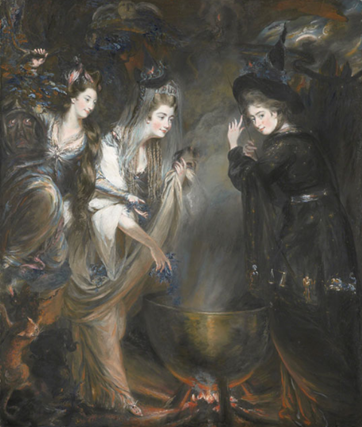
Image: Macbeth’s three Weird Sisters as portrayed by Daniel Gardner, 1775
Shakespeare himself was born into a world of witchcraft. In April 1563, exactly one year before the birth of Shakespeare, Queen Elizabeth I passed the Witchcraft Act. This act took away power from the church courts, which had previously dealt with the crime of witchcraft, and put it into the hands of the common law courts, making ‘murder by witchcraft’ a crime punishable by death. At the time of Shakespeare’s birth, magic was seen as an integrated part of daily life. ‘White magic’ offered protection against evil, while witches were viewed as Maleficium – those who engaged in the supernatural with the intent of causing harm to people and property.
But what do Shakespeare and witchcraft have to do with heritage homes? If you live in a property that is dated from 1500s-1600s, it is possible that the walls of your house tell the story of how the former residents interacted with the culture of magic that existed at the time.
The official stance of the Church was that all aspects of magic were an offence against God, therefore should not be tolerated in a Christian society. However, apotropaic (protective) magic still found its way into people’s homes, with carvings of ‘Marian Marks’ – AM (Ave Maria – Hail Mary), and VV (Virgo Virginum – Virgin of Virgins) being hastily etched at times of desperation, such as during the illness of a family member or when food supplies were low.
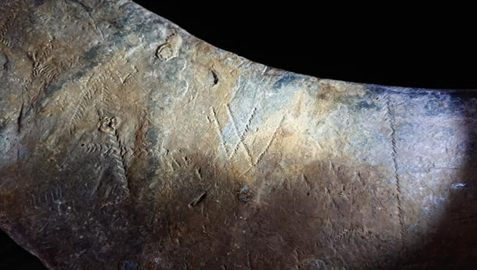
Image: An example of a VV Marian mark. Courtesy of Apotropaios.
If a 1500s property was to be searched, the placement of any discovered Marian marks would reveal not only that the former residents were believers in apotropaic magic, but the reason behind the carving.
Looking upwards at the doorframe of a bedroom, or on the wall where a bedframe might have once stood, a Marian mark will denote that a sickness, usually a fever, had struck in the heart of a family. In a world pre-dating modern medicine, a fever was seen as an attack by dark, satanic forces. Calling upon the both the healing spiritual energies of white magic and God, a family carved their pleas to the Virgin Mary. Apparent overlaying of the marks symbolises how a fever may have progressed and how the family reacted: as the fever worsened each carved repetition of the Marian mark suggests that the family was becoming increasingly frantic.
When James I came to power, the country’s preoccupation with witches turned into a craze. Witches were no longer considered to be women who supernaturally created harm and suffering, but those who had given away their soul to the devil in exchange for supernatural powers. James I himself was gripped with a fear of witches. In 1589, his betrothed, Anne of Denmark, set sail to Scotland. Her fleet was barraged by storms, and the flotilla was forced to seek shelter.
Officials claimed that the cause of the disruption was the plotting of witches. In both Copenhagen and Scotland several women were murdered, accused of being members of witch covens conspiring against the King and his future bride. A little under a decade later, James I authored Daemonologie (1597) in which he outlined the ‘devil pact’ made by witches, as well as describing the different spirits, phantoms and fairies that torture people. Shakespeare harnessed this burgeoning fear in his writing of Macbeth.
The concept of evil manifesting in the form of flying or travelling spirits created a new anxiety, with points of entry such as windows and doors being considered vulnerable, and the chimney being viewed as a particular weakness. In response to this wave of terror, the use of apotropaic magic intensified: witch bottles filled with nail clippings and sharp objects, dried cats and handwritten spells were often hidden in and around the chimney. Professional carpenters were hired to carve six-sided daisy wheels or hexafoils into areas that a family believed needed additional protection.
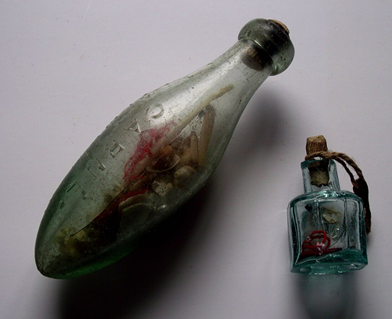
Image: Examples of Witch bottles
At Shakespeare’s birthplace, there are a couple of hexafoils on the staircase directly above the cellar. Historians estimate that they would have been carved in about 1600 to protect the beer stores. However, some historians question the validity of the hexafoils as a witch mark and offer an alternative explanation that they are simply the mark of a stonemason.
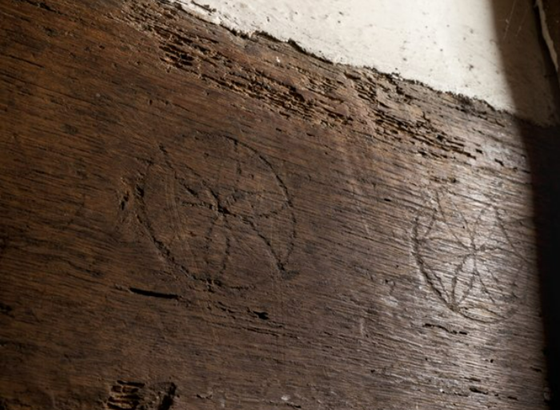
Image: the pair of hexafoils at Shakespeare’s birthplace. Courtesy of Shakespeare Birthplace Trust
In the next article, the question “Could your home have housed people undergoing a personal rebellion?” is explored.
Our journal, Built to Last, asks the question ‘What does it mean to be a good custodian?’ Through essays, conversations and stories rooted in real buildings and the people who care for them, we explore what it takes to preserve an old home’s fabric and its story - and the decisions that shape both.
At Pursuing the Past, we research and write beautifully presented House Stories, turning historical detail into lasting pieces of storytelling that deepen your connection to your home and invite you to take your place as custodian of its continuing story.