Domesticity and Femininity
“My noble father, I do perceive here a divided duty: To you I am bound for life and education; My life and education both do learn me How to respect you; you are the lord of duty; I am hitherto your daughter. But here’s my husband” ~ Desdemona, Othello (Act 1, Scene 3)
On 8th December 1660, history was made when Margaret Hughes trod the boards of the Vere Street Theatre, making her the first woman to perform as a professional actress on a public stage in England. Thirty years earlier, French actresses had been forced to flee the stage amid intense hostility and jeering crowds. But in the early days of the Restoration, public perception of women existing outside of domestic circles was changing, its perceived shamefulness was lessening.
The relationship between women and the domestic spaces which have bound them is a fraught one. This article explores how women were cast as angels and how they survived playing the role of housewife.
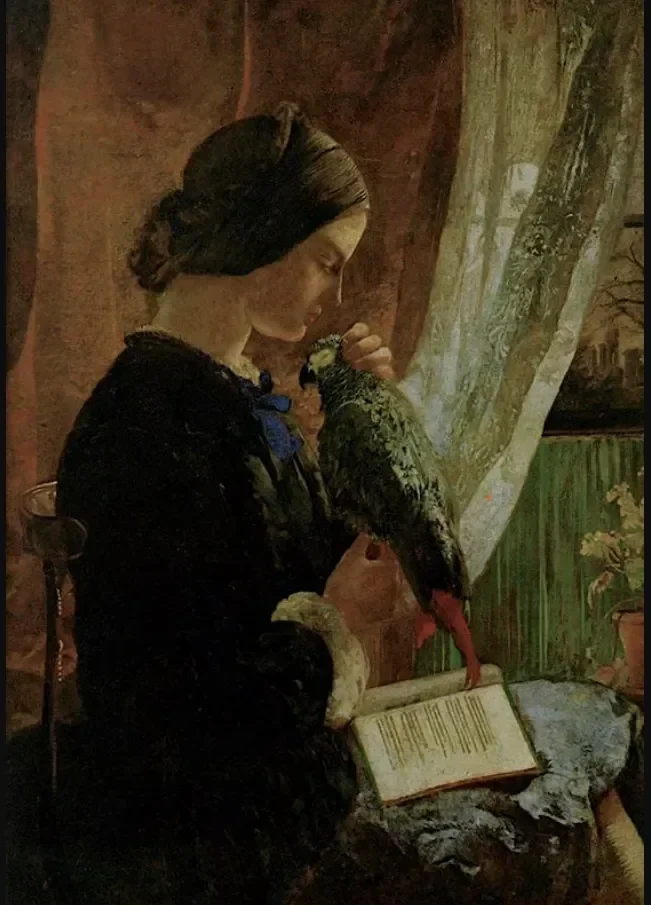
DRAMATIS PERSONAE
Eleanor Farjeon – English Author
Margot Asquith – British Socialite and Author
John Ruskin - English Polymath and Writer
Christina Rossetti – English Writer and Poet
Florence Nightingale - English Social Reformer, Statistician and the Founder of Modern Nursing
Elizabeth Missing Sewell - English Author of Religious and Educational Texts
ACT 1: A Kingdom of its Own
SCENE I
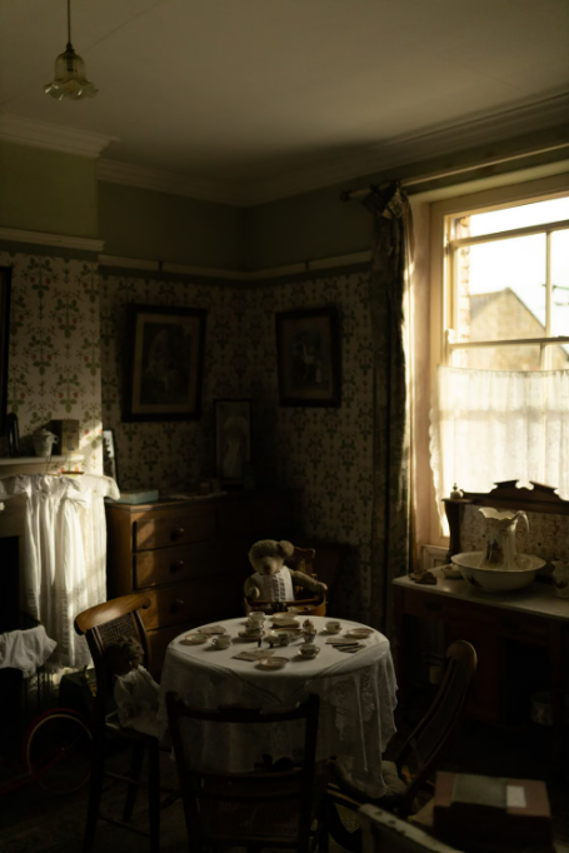
The interior of a Victorian townhouse. A child’s nursery. Daylight. Three children, two girls and a boy, sit around a table. Nanny stands immediately to their left, shrewdly observing them. ELEANOR FARJEON stands STAGE LEFT and addresses the audience.
“The nursery was a kingdom of its own, and Nanny was the queen. Outside its doors lay a strange, adult world, but inside, everything was known…”
The cocoon of the nursery floor could be a haven, a blissful refuge of imaginations and daydreams. But for some girls, learning the separate spheres inhabited by men and women began at a tender age. If a girl had a brother, it would soon become clear that, even in the reign of Queen Victoria, the world she inhabited was a kingdom, not a queendom. She and her brother may begin life on the nursery floor dressed in identical petticoats, but there was an established hierarchy emerging from birth. From her brother being offered better cuts of meat to being first to select the treats from the sweet tray, a girl was given a subtle introduction to a life spent in deference to a man. Her brother would be allowed to roam through the house and get muddy playing in the garden, while she must help Nanny tidy his discarded toys and scrub the mud from his shorts; she must remain prim and proper in the nursery. From the earliest age, a girl might realise that even a protective cocoon could be a prison.
SCENE II
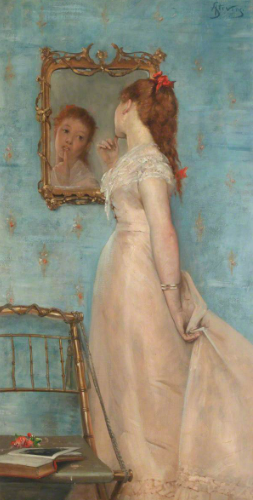
The interior of a day nursery. Evening. Oil lamps illuminate a young girl as she stares contemplatively into the looking glass. Enter STAGE RIGHT MARGOT ASQUITH.
“We were always told to sit up straight and not to look at ourselves in the glass...”
Victorian young ladies were actively prevented from admiring themselves in the looking glass. The reasons ranged from discouraging vanity to the superstition that a looking glass could trap a person’s soul. However, the relationship between a girl and her reflection also speaks to her relationship with the home. “We were… not to look at ourselves in the glass”, Margot Asquith said. As a girl grew into a young lady, the education she received emphasised that she was to grow up not to be herself, but a rather a reflection of a man’s ideal. Victorian society prescribed to girls the role of ‘helpmeet’; the home was a man’s idyll, his refuge from the darkness of the world, and the woman’s purpose was to be the facilitator of his vision.
Learning to be a helpmeet began at age seven. While her brother studied Latin, geography and sciences with a tutor, a girl would practise piano or needlework. Occasionally, she might be encouraged to sit alongside her brother as he studied, but not for her own benefit.
Enter STAGE LEFT JOHN RUSKIN.
“A woman ought to know the same language, or science, only so far as may enable her to sympathise in her husband’s pleasures, and in those of his best friends.”
From the age of ten, a girl’s education transitioned fully from academics to accomplishments; schooling focused on conversational French and painting in addition to piano and needlework, her talents at which would be regularly showcased in the drawing room.
When she reached fourteen, a girl would shadow her mother, being instructed in the day to day running of a household. She would learn everything from budgeting to servant management.
CHRISTINA ROSSETTI stands CENTRE STAGE.
“Woman was made for man’s delight,--
Charm, O woman! Be not afraid!
His shadow by day, his moon by night,
Woman was made…
Fair as the moon and joyful as the light:
Not wan with waiting, not with sorrow dim;
Not as she is, but was when hope shone bright;
Not as she is, but as she fills his dream.”
As a girl reached eighteen, she had donned her wings and was prepared to step into her role as the Angel of the House.
ACT II: The Gaslight Effect
SCENE I
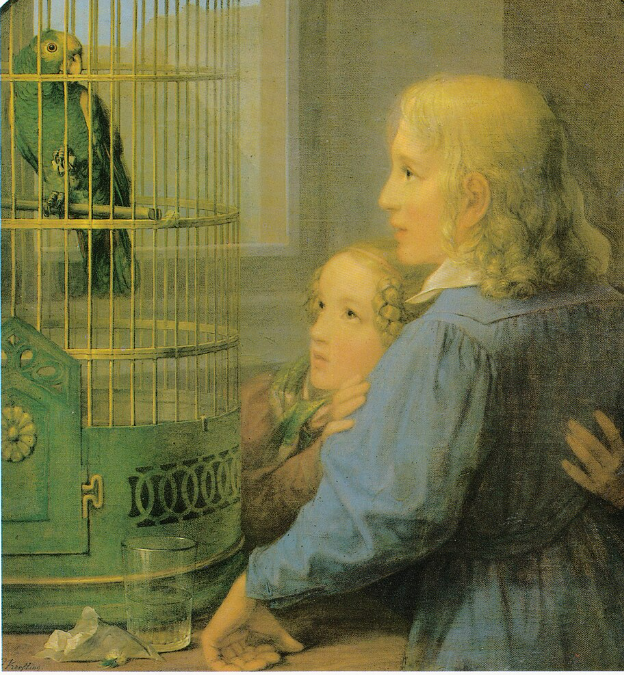
A drawing room. Late evening. As oil lamps burn brightly, a bird in an ornate cage sings a mournful trill.
Enter STAGE LEFT FLORENCE NIGHTINGALE.
When shall we see a life full of
steady enthusiasm, walking
straight to its aim, flying home, as
that bird is now, against the
wind—with the calmness and the
confidence of one who knows
the laws of God and can apply
them?
The Victorians were fond of keeping birds in cages. Bird-keeping built up to a crazed fascination from the 1850s through to the 1890s, with every household keeping at least one bird. The birds became symbolic of an idyllic, harmonious home, a responsibility they shared with the women.
Enter STAGE LEFT ELIZABETH MISSING SEWELL.
“A woman is to be his help-meet, — to fill up that which is wanting in him . . . ; to complete what, from the imperfection of his nature, would otherwise be incomplete.”
The designation of ‘Angel of the House’ was born out of the separate spheres’ ideology. These beliefs enforced the idea that the roles men and women played within society were dictated by gender: a man’s work would take him outside of the home, whereas a woman’s fragile and pure nature made her solely suitable for domesticity.
Entering into marriage was the only viable option available for women. Their education and social conditioning primed them for a lifetime of being a homemaker and marriage alone provided shelter, financial security and a social standing. A woman’s role within the home was one of self-renunciation: she was to bear her husband his children and exact his vision for the home. From choosing the household furnishings to be delicate, soft and feminine to creating an atmosphere of tranquillity, a woman would sacrifice her sense of self to offer up a projection of heaven.
Enter STAGE RIGHT CHRISTINA ROSETTI.
“God harden me against myself,
This coward with pathetic voice
Who craves for case and rest and joys”
Upon entering the Victorian household, birds would abandon their dawn chorus for warbling in the evening in response to the harsh artificial lighting. This was known as the Gaslight Effect. Just as Victorian society defended the caging of their birds, a woman too was gaslit into believing a life of nothing but domesticity was right for her. Singing melodically and making home in a gilded cage can be comforting, no longer having to battle the harsh weather or threat of predators.
Some women took naturally to the self-renunciation of their role and delightedly lost themselves in motherhood and homemaking, ensuring that their home was one of efficiency and morality. They viewed their role as highly moral and a spiritual calling. Clinging to the illusion of moral supremacy and viewing captivity as protection was a soothing story for women to tell themselves.
Enter STAGE LEFT FLORENCE NIGHTINGALE.
“Behind his destiny woman must
annihilate herself, must be only
his complement… A man
gains everything by marriage: he
gains a “helpmate,” but a woman
does not… All their plans and visions
seem vanished, and they know
not where; gone and they cannot
recall them. And they are left
without the food either of reality
or of hope…”
For others, the burden of the Angel of the House weighed heavy. If a man’s relationship to the home was an idyll born out of separation, a woman’s could be the antithesis: a prison, a hell on earth. The restrictions surrounding a woman’s intellect and dreams, as well as the expectation of constant equilibrium, meant the home was a millstone around their necks. Under Common Law, a married woman surrendered her rights and came under the ultimate authority of her husband. A marriage could be supportive, but it could be violent; both possibilities were deemed legal.
Whenever a domesticated bird refused to take to its cage and threw itself insistently against the bars, a remedy was doled out in the form of starvation and the practice of sticking, where a bird was blinded by a heated needle. Singing became easier once a bird was blind to its surroundings and had lost its concept of night and day.
Some women discovered it was possible to fan the flames of hell, that the guise of Angel of the House could transfigure into a ministering angel – a woman’s higher sense of morality could be applied to philanthropic work, allowing them to gain administrative and leadership skills and develop a position in public life.
Established in 1889, the RSPB was founded by Emily Williamson. It began as a campaign led by women who used their charitable efforts to fight for the right of caged birds to be free.
Epilogue
All actresses have different approaches to storytelling. Some favour method acting, where a role is inhabited so deeply that it is almost impossible to separate where the character begins and the actress ends. Others enjoy the masquerade, seeing how adopting a role can be used to their advantage. These were the techniques employed by Victorian women trying to survive in their position as ‘Angel of the House’.
Our journal, Built to Last, asks the question ‘What does it mean to be a good custodian?’ Through essays, conversations and stories rooted in real buildings and the people who care for them, we explore what it takes to preserve an old home’s fabric and its story - and the decisions that shape both.
At Pursuing the Past, we research and write beautifully presented House Stories, turning historical detail into lasting pieces of storytelling that deepen your connection to your home and invite you to take your place as custodian of its continuing story.