Three extraordinary stories behind Britain’s most ordinary house name
In the UK there are certain property names that crop up more often than others. The Old Schoolhouse, Manor Farm, Old Forge, etc, etc. One of these common names is the Old Vicarage, which appears on village signs and estate agents’ boards across the country, usually attached to a handsome period property with a church somewhere in the vicinity. You can usually picture it before you’ve seen it: a few sash windows, a decent-sized garden, an unnecessarily imposing front door… you know the sort.
These properties are respectable and beautiful, but not necessarily the most exciting.
However! I’ve been looking into the stories behind Britain’s old vicarages, and it turns out that some of these properties have been home to some very exciting characters. There are mathematicians, astronomers, literary connections and even a family at the centre of a criminal investigation that attracted the attention of Sherlock Holmes’s creator.
It seems an Old Vicarage wasn’t always quite as quiet as its name suggests.
Why are they called vicarages?
First, some clarification. The word vicarage has been around since the fifteenth century, originally referring to the income or benefice assigned to a vicar, before it came to mean the house in which he lived. The word vicar itself comes from the Latin vicarius, meaning a substitute or deputy. In medieval England, a vicar was effectively the priest appointed to serve a parish when its original income had been appropriated by a religious institution, such as a monastery.
There is a difference between a vicarage and a rectory. Although the words are often used interchangeably, they originally described different ecclesiastical arrangements. A rector generally received the greater share of a parish’s income, while a vicar received a portion set aside to support his work. Both might have a house provided as part of their position, and both could end up living in rather impressive properties.
Not every vicarage was a grand residence, of course. Some were modest cottages, others substantial country houses, and many were altered as successive clergymen and their families came and went. When the Church began selling off larger clergy houses in the twentieth century, plenty passed into private ownership. The name often stayed behind (with ‘Old’ added at the front for clarification), even when the new occupants had absolutely no intention of conducting Sunday services from their living rooms.
Here are three that I thought sounded interesting.
1. The Old Vicarage, Potterspury
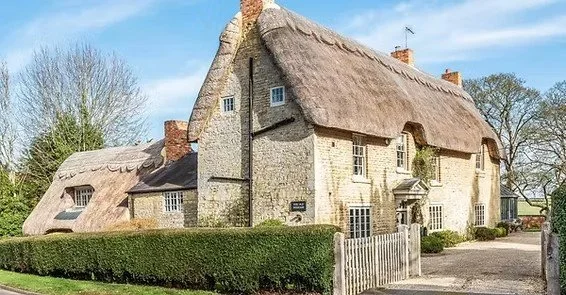
The Old Vicarage, Potterspury
This Old Vicarage was home to the Reverend John Hellins, a man whose interests extended considerably further than the average parish sermon.
Hellins became vicar of Potterspury in 1790, having taken an unusual route into the Church. Born into a poor family in Devon, he was apprenticed to a cooper and taught himself mathematics while working with wooden barrels. His abilities eventually brought him to the attention of the astronomer Malachy Hitchins, who helped secure him a position at the Royal Observatory in Greenwich. There, he worked under the Astronomer Royal, Nevil Maskelyne, studying the movements of celestial bodies and developing his mathematical knowledge.
He eventually qualified for holy orders and took up the living at Potterspury. The Reverend Hellins was no ordinary country parson: he became a Fellow of the Royal Society in 1796 and received its prestigious Copley Medal in 1798 for his mathematical work. He continued publishing mathematical papers while serving his parish, which must have made for some interesting conversations over the garden fence.
His home was the Old Vicarage, a seventeenth-century thatched house opposite St Nicholas Church. Local history records that Hellins carried out mathematical experiments and calculations in its grounds. He also produced a valuation of the living of Potterspury in 1808, recording the property, its orchard and half an acre of land.
The house’s time as a vicarage eventually came to an end, but not without a peculiar property arrangement. In 1866, the Reverend Robert Emans Crawley persuaded the Duke of Grafton to exchange the old, thatched residence for a larger property further up the hill. The vicar moved into his new home, bringing the bay windows with him. Yes, really: the windows were removed from the old house and installed in the new one!
2. The Vicarage, Great Wyrley
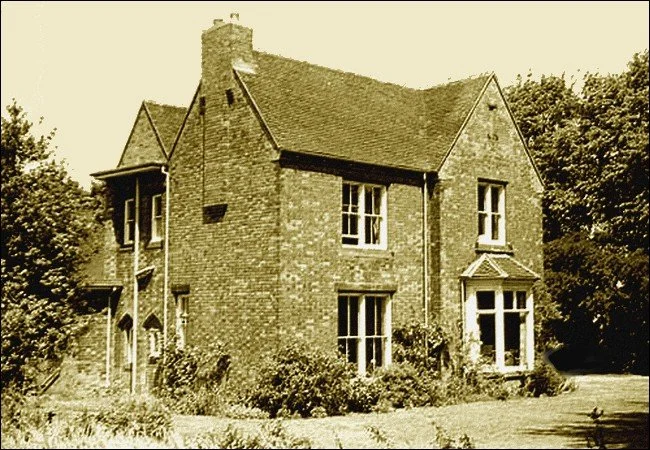
The Vicarage, Great Wyrley
The vicarage at Great Wyrley, Staffordshire, has a darker chapter in its history. During the late nineteenth century, it was home to Reverend Shapurji Edalji and his family. Born in Mumbai, Shapurji was a Parsi who converted to Christianity and travelled to England to train for the priesthood. He became vicar of Great Wyrley in 1876, in what was an unusual appointment for the period. He is believed to have been among the first South Asian clergymen to lead an English parish!
His son George grew up in the village, eventually qualifying as a solicitor. Then, in 1903, a strange series of brutal attacks on horses and other animals around Great Wyrley sent the local community into a panic. George was arrested, tried and convicted of maiming horses, receiving a seven-year prison sentence. The evidence against him was deeply questionable, and the case has since been widely discussed in the context of the racial prejudice experienced by the Edalji family.
George’s conviction attracted national attention, and his father campaigned vigorously for his release. Eventually, another rather famous figure entered the story: Sir Arthur Conan Doyle. The creator of Sherlock Holmes took a personal interest in the case, investigating the evidence and publicly challenging the conviction. His involvement brought further publicity and helped force the authorities to reconsider what had happened.
George was released in 1906 and received a free pardon in 1907, although the authorities stopped short of formally declaring him innocent. It’s quite a story to find attached to an ordinary village vicarage. Behind its regular front door lived a family whose experience of prejudice, public scandal and an extraordinary legal campaign would become part of British criminal history.
3. The Old Vicarage, Godalming
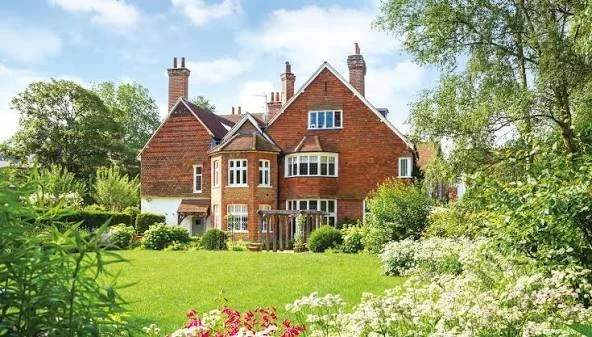
The Old Vicarage, Godalming
Our final stop is the Old Vicarage in Godalming, Surrey, a house with a particularly long association with the parish. The site has been occupied by successive clergymen since at least 1185, with at least 55 vicars recorded as having lived there over the centuries. That’s a remarkable number of incumbents, and a lot of history to fit into one address.
The present building is a mixture of Georgian and Victorian architecture, although its oldest surviving section dates to the seventeenth century. Built in Bargate stone, it has undergone numerous alterations over the years, reflecting the changing requirements of the people who called it home. The house was reportedly offered for sale with a substantial written history of its inhabitants, which is where some of its more colourful connections emerge.
Among the visitors said to have passed through its doors were Charles Dickens, Lewis Carroll and Lord Baden-Powell. The house also witnessed celebrations marking Queen Victoria’s Diamond Jubilee in 1897. I would love to know what Dickens made of the place, although the available property history unfortunately doesn’t give us a detailed account of his visit.
By the time it came onto the property market in recent years, the Old Vicarage was being described as a substantial private residence, with seven bedrooms and around 7,400 square feet of accommodation. It was reportedly only the second time in its 400-year history that the property had been offered for sale. After centuries of clergymen, parish business and distinguished visitors, it had become a rather impressive family home.
So, the next time you encounter an Old Vicarage (and if you live in Britain, you will!), consider that it may have housed a mathematician who once worked at the Royal Observatory, or been the family home at the centre of a notorious miscarriage-of-justice case, or welcomed some of Britain’s best-known literary and historical figures.
You never know what history might be hiding behind a front door, especially if the building name starts with the word ‘Old’.
Our journal, Built to Last, asks the question ‘What does it mean to be a good custodian?’ Through essays, conversations and stories rooted in real buildings and the people who care for them, we explore what it takes to preserve an old home’s fabric and its story - and the decisions that shape both.
At Pursuing the Past, we research and write beautifully presented House Stories, turning historical detail into lasting pieces of storytelling that deepen your connection to your home and invite you to take your place as custodian of its continuing story.