These historic houses have some chilling stories to tell
Now if there’s one thing about me, it’s that I’m terrified of ghosts but love a good ghost story, so please read and enjoy this article in the knowledge that it’s probably been the source of my nightmares for the past week.
Britain has hundreds of historic houses with stories of strange apparitions, unexplained noises and former residents who apparently missed the memo about moving on. Some of these tales have been around for centuries, some became famous thanks to a photograph, a particularly gruesome rumour or someone who swore they saw something they couldn’t explain. Naturally, as we round the corner towards Halloween, I’ve been looking into some of the best-known examples.
Side note: if you’re like me and are spooked easily by the paranormal, maybe don’t read this immediately before bed. Or at all.
Raynham Hall, Norfolk
Let’s start with what might be the most famous ghost photograph ever taken.
In 1936, photographers from Country Life magazine were visiting Raynham Hall in Norfolk, photographing the house’s interiors. While working around the grand staircase, one of them, Indre Shira, reportedly spotted a hazy figure coming down the steps. He called to his colleague, Captain Hubert Provand, who managed to take a photograph before the apparition disappeared. When the image was developed, it appeared to show a translucent woman floating down the staircase.
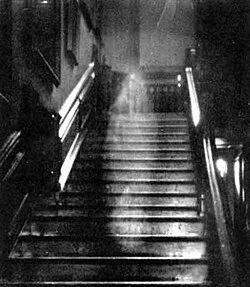
1936 photograph from Raynham Hall
The photograph became known as the Brown Lady of Raynham Hall, and it’s been puzzling people ever since. The woman was supposedly Dorothy Walpole, sister of Robert Walpole, Britain’s first prime minister. She married Charles Townshend, the second Viscount Townshend, in 1713, and according to the ghost story, her husband discovered her alleged infidelity and imprisoned her in the house. She is supposed to have remained there until her death in 1726, condemned to spend eternity wandering the place where she’d been confined.
It’s a wonderfully dramatic story, but the historical evidence is much less exciting. Dorothy’s supposed imprisonment hasn’t been firmly established, and the photograph itself is far from conclusive proof of anything supernatural. An investigation by the Society for Psychical Research in 1937 suggested there was probably an ordinary explanation for the image. Still, it’s easy to see why the photo became so famous.
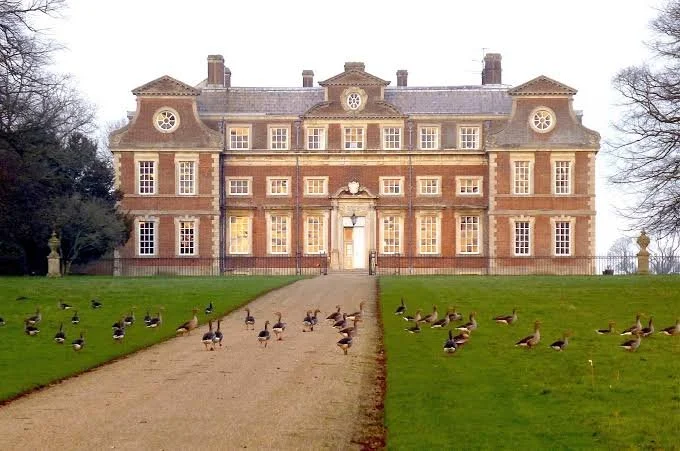
Raynham Hall (& ducks)
Raynham Hall is an enormous country house with a long architectural history, and its sweeping staircase makes a perfect setting for a ghost story. I love that the team that day were there to professionally photograph the house, only for a hasty snapshot taken on a whim to become (presumably) the best photo of the day! Whether the Brown Lady actually ever appeared or not, she’s certainly made sure Raynham Hall will never be known for its interior design alone.
Blickling Hall, Norfolk
If you thought that being beheaded was a fairly definitive way to leave this world, you might spare a thought for poor Anne Boleyn.
The second wife of Henry VIII was executed in 1536, but according to legend, she still makes an annual appearance at Blickling Hall in Norfolk. On 19 May, the anniversary of her death, she supposedly returns to the estate in a carriage drawn by headless horses, carrying her own severed head, while other versions describe a ghostly figure wandering around the grounds and corridors.
Anne is believed to have been born at Blickling, although the details are uncertain. Her family owned the estate before the present house was built, and the building you can see today is a grand Jacobean mansion constructed in the early seventeenth century by Sir Henry Hobart. It’s full of elaborate plasterwork and impressive interiors – it’s pretty much asking to be haunted.
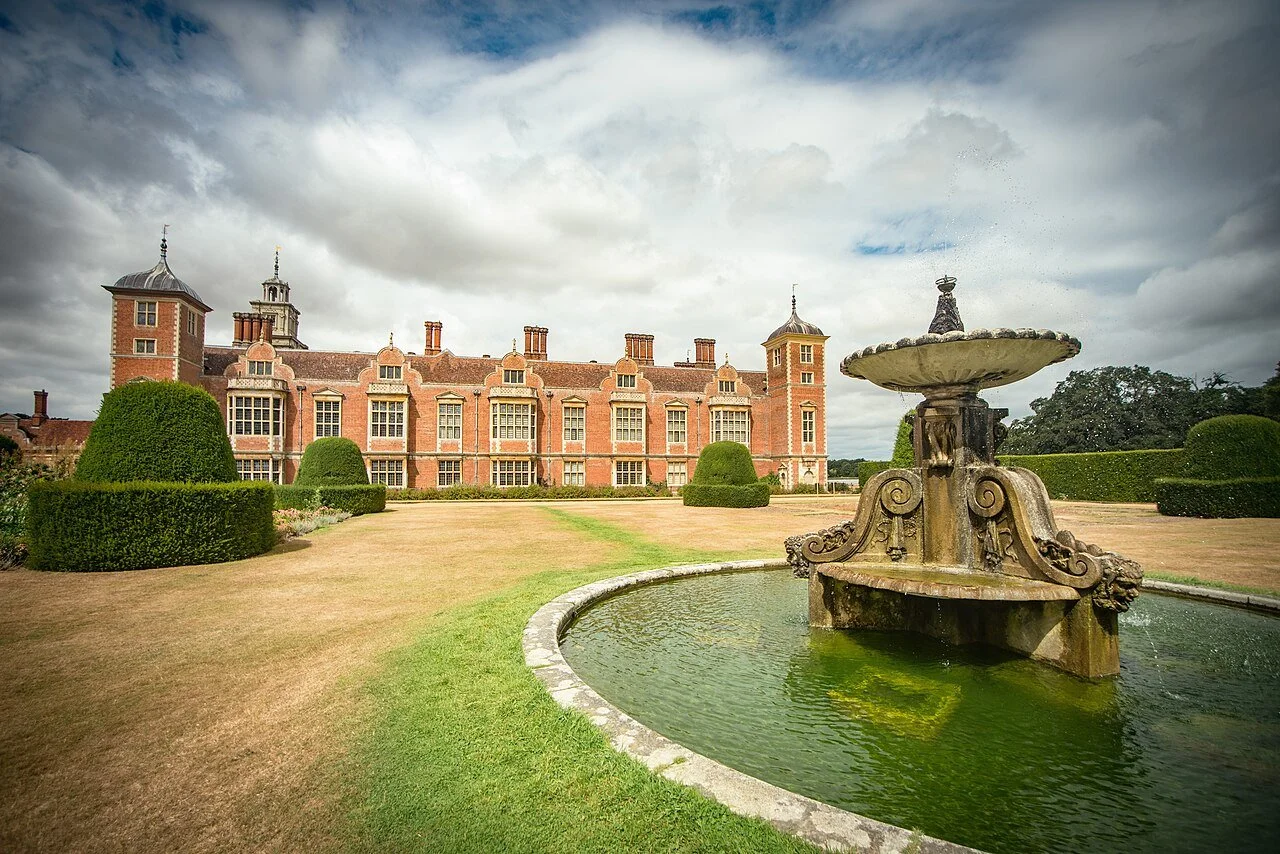
Blickling Hall
The unfortunate truth with this one is that the house itself is later than Anne’s lifetime. The present Blickling Hall was built more than eighty years after her execution, on the site of the earlier Tudor manor. So while the ghost story is attached to the estate, the building she is meant to haunt isn’t the house she would have known. The architecture belongs to a later period, but the legend keeps the Tudor past close at hand.
As with most ghost stories, the details vary depending on which version you read. Some accounts associate the headless carriage with Anne herself, while others involve her father, Thomas Boleyn, or her brother, George. What remains consistent is the idea that the family’s tragic history has left a supernatural mark on the estate.
I’m not sure there’s a more theatrical way to arrive at a country house than in a carriage pulled by headless horses, so I can see why the story has stuck!
Chillingham Castle, Northumberland
For something a little more grim, we’ll head north to the best named haunted castle I’ve ever heard: Chillingham Castle.
This thirteenth-century fortress has a reputation as one of Britain’s most haunted buildings, with stories involving ghostly children, mysterious lights and figures that appear in its rooms. Its thick stone walls and gloomy interiors definitely help to set the spooky scene, along with a medieval dungeon and torture chamber! Chillingham was built during a period when the English-Scottish border was a dangerous place, and its defensive architecture reflects a history of conflict. The castle looks intimidating even without any supernatural assistance.
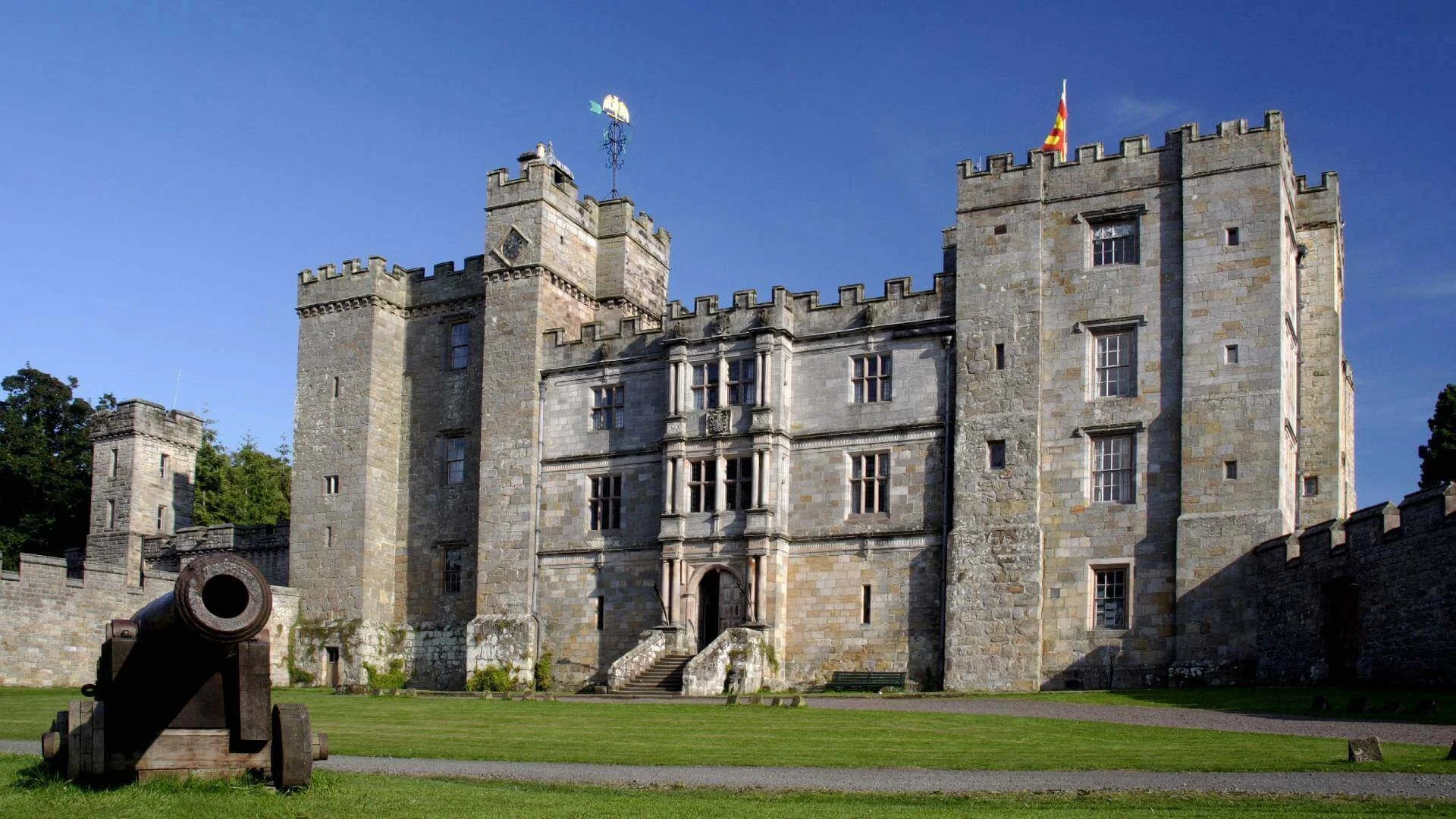
Chillingham Castle
The castle’s best-known story concerns the Blue Boy, a child said to haunt the room now known as the Pink Room (funnily enough). Guests have reportedly heard a boy crying, and seen flashes of blue light. Then comes the really unpleasant part: during building work in the early twentieth century, human remains were discovered behind a wall. The remains were said to belong to a child, and the story developed that he had been bricked up there alive. After the bones were given a proper burial, reports of strange sightings continued nonetheless.
There’s no reliable evidence to confirm that a child was murdered in this way, so the story remains firmly in the territory of local legend, but personally that isn’t going to stop me from having nightmares. This account of someone’s visit to the castle as a child is worth a read!
You have to admit that the idea of a child trapped in behind a wall is very creepy, especially in a medieval castle. These buildings have thick masonry, plenty of blocked up openings, and spaces which have been continuously altered over centuries. You can stand in a perfectly ordinary room and have absolutely no idea what lies behind the plaster or stone around you. The architecture gives the story an unsettling sense of possibility, even if it doesn’t prove anything supernatural happened.
The Blue Boy isn’t the only spirit said to haunt Chillingham. There’s also Lady Mary Berkeley, who supposedly died in 1719 after her husband left her for her sister. Visitors and staff have reported unexplained floral scents and the sound of a rustling dress, which are attributed to her ghost. Other tales describe a mysterious woman appearing in a locked room. As ever, these are reports and legends rather than verified paranormal encounters, but they’ve helped make the castle a favourite with people who enjoy a good haunting.
Would you spend the night? (no thank you)
So. Raynham Hall has a famous, century-old photograph that still invites debate. Blickling Hall has a Tudor ghost story that has grown more dramatic over time. Chillingham Castle has it’s a tale of a child concealed behind a wall. You don’t have to believe in ghosts to find any of them fascinating, even though none of these accounts establishes that anything paranormal has actually happened.
But the buildings themselves are indisputably real, and their architecture gives the stories somewhere to take root. They’ve long outlasted the people who first lived in them, and the stories have outlasted them, too.
I’m not sure I’d be particularly keen to investigate any unexplained noises there in the middle of the night, but I would love to wander around all three during the day. You wouldn’t catch me hanging around any staircases on my own though.
Our journal, Built to Last, asks the question ‘What does it mean to be a good custodian?’ Through essays, conversations and stories rooted in real buildings and the people who care for them, we explore what it takes to preserve an old home’s fabric and its story - and the decisions that shape both.
At Pursuing the Past, we research and write beautifully presented House Stories, turning historical detail into lasting pieces of storytelling that deepen your connection to your home and invite you to take your place as custodian of its continuing story.