What brick bonds can reveal about historic buildings
There is perhaps nothing more innocuous than an old brick wall. Row after row, hundreds or thousands of individual bricks fit together to form something completely normal looking: a solid surface that keeps the weather out and a building standing.
You might think that there’s nothing to be gleaned from a wall such as this, but if you were to look a little closer, things start to reveal themselves as very deliberate. With a Flemish brick bond, some bricks show their long faces, others their short ends, and the pattern changes from building to building with Running, Common and English bonds also used. These different arrangements are known as brick bonds, and they reveal something about the way historic buildings were made.
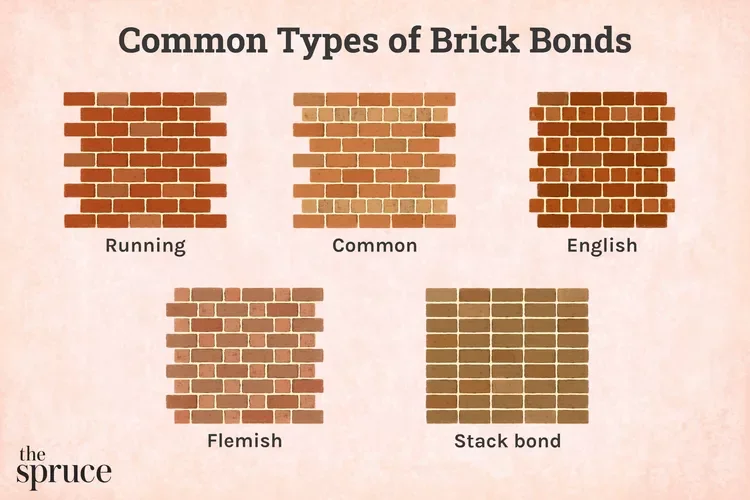
Credit: The Spruce / Mira Norian
Brick bond is not simply a matter of decoration. Bricks cannot safely be stacked in continuous vertical columns, as the resulting wall would be weak. Instead, they are laid so that the joints between bricks overlap, creating a more stable structure. Different patterns developed over time, with English bond and Flemish bond among the most recognisable forms of historic brickwork in England. Looking at the difference between them offers a small but revealing glimpse into the knowledge and craftsmanship that went into building houses that could survive for centuries.
The simplest way to understand the two is to look at the faces of the brick. A stretcher is the long side of the brick, while a header is its short end. In English bond, entire courses alternate: one row consists of stretchers, followed by a row of headers, then another of stretchers. In Flemish bond, the pattern changes within each individual course, with headers and stretchers alternating along the same row. The difference is easy to recognise once you know what to look for, but both arrangements are examples of the same fundamental principle: overlapping the bricks so that the wall acts as a coherent structure rather than a stack of separate pieces.
The choice of bond could also tell us something about when a building was constructed. Historic England’s guidance on traditional brickwork notes that English bond was commonly used in earlier brick buildings, while Flemish bond became increasingly common in many areas during the eighteenth century. Early bricks were often thinner and less regular than later examples, with thicker mortar joints, while later handmade bricks tended to be more consistent in size. The change was therefore not simply a matter of builders suddenly preferring one attractive pattern over another: brick-making itself was changing, as were architectural fashions and the ways in which brick was used.
The bricks themselves carry evidence of this process. Before the widespread use of machine-made bricks in the late nineteenth century, bricks were mostly made by hand, and their appearance could vary according to the clay, moulding and firing process. The temperature reached in the kiln affected their colour and hardness, while bricks that became particularly dark through intense firing could sometimes be deliberately incorporated into decorative patterns. Historic England notes that variations in brick colour, size, mortar and bonding can all help reveal different phases of construction.
This makes brickwork very useful when trying to understand a building that has changed over time. Historic houses rarely remain exactly as their first builders left them. Extensions, alterations and repairs can leave subtle boundaries in the fabric of a building, and a change in brick bond can be one of the clues that reveals where one phase ends and another begins.
Chillenden Forge in Kent provides a particularly good example. The building began as a forge in around the seventeenth century, with its earlier cross range constructed largely from handmade red brick laid in English bond. In about the mid-nineteenth century, the forge was extended with a new range built in Flemish bond. The two phases can still be distinguished in the surviving brickwork: the earlier English bond contrasts with the later Flemish bond, while the junction between the ranges provides physical evidence of the building’s expansion.
Other historic houses show just how varied brick bonding can be within a single building. Spains Hall in Finchingfield, Essex, for example, dates largely from the late sixteenth century but incorporates additions from several later periods. Its brickwork is mainly English bond, with areas of Flemish bond surviving alongside earlier timber framing.
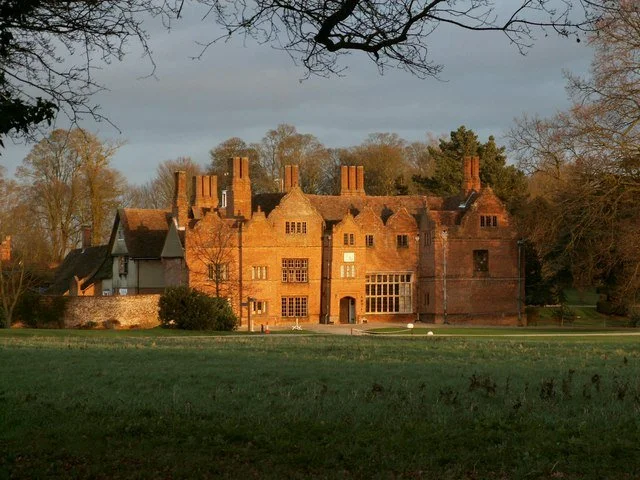
Spains Hall in Finchingfield, Essex
Royton Manor in Kent provides another particularly clear example: its complex history spans several centuries, and different parts of the house contain both Flemish and English bond brickwork. In buildings such as these, changes in brickwork are part of the evidence that allows us to understand how a house developed over time.
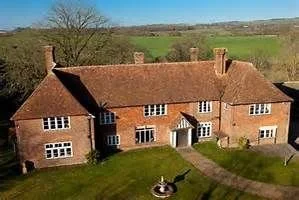
Royton Manor, Kent
Even where the reason for a particular choice is no longer known, the brickwork demonstrates the practical knowledge required of the people who built it. A historic bricklayer had to work with the materials available, maintain a consistent bond and create openings, corners and changes in the wall without compromising the construction. The finished pattern may look repetitive, but producing it across an entire building required considerable skill and precision.
That is part of what makes old brick buildings so rewarding to look at. Their history is not confined to archives or inscriptions above the door. It is embedded in the fabric itself. A change in brick colour can mark a different firing process; a different mortar can indicate a later repair; a change from English to Flemish bond can reveal that an extension was added generations after the original building.
Once you know how to recognise English bond and Flemish bond (and now you do!), an old brick wall becomes something more than just a backdrop. The people who built these houses did not have modern manufacturing or construction technology, but they understood how to make the materials available to them work. They knew how to turn clay into bricks, bricks into walls and walls into buildings capable of enduring long after their own lives had passed.
That is what makes a building Made Well. Its longevity begins long before the first signs of age appear: in the material chosen, the knowledge applied to it and the care with which thousands of small pieces are made to work together. In an old brick wall, that craftsmanship is still there to be seen in every individual brick.
What can you see in your own property? Take a closer look at the brickwork around your home. Do you recognise English or Flemish bond, or do different parts of the house use different patterns? Changes in brickwork can sometimes reveal when a building was extended, altered or repaired, offering clues to the story hidden within its walls.
Read more about brick bonds and how bricks were made here.
Our journal, Built to Last, asks the question ‘What does it mean to be a good custodian?’ Through essays, conversations and stories rooted in real buildings and the people who care for them, we explore what it takes to preserve an old home’s fabric and its story - and the decisions that shape both.
At Pursuing the Past, we research and write beautifully presented House Stories, turning historical detail into lasting pieces of storytelling that deepen your connection to your home and invite you to take your place as custodian of its continuing story.