What Clandon Park teaches us about thoughtful custodianship.
Shortly after 4pm on a spring afternoon in April 2015, smoke was seen rising from the roof of National Trust property Clandon Park in Surrey.
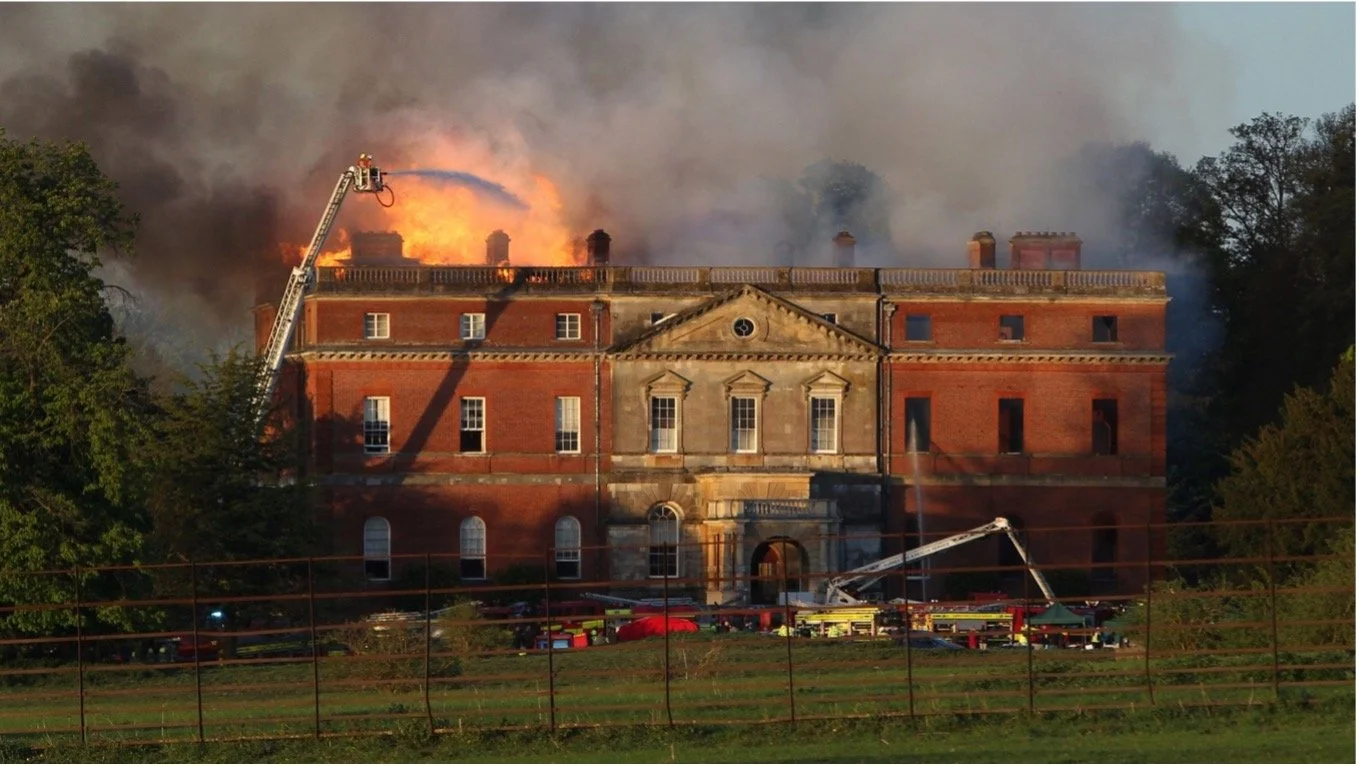
At first it looked like something that might be contained, but the fire took hold quickly in the roof space and spread through the structure of the old building, feeding on the hidden timber and voids within the eighteenth-century house.
By the time it was brought under control, much of the interior had been destroyed and the roof had collapsed, leaving only the external brick shell and fragments of decoration behind. What had been one of the country’s most important Palladian houses was still standing, but it wasn’t the same as it had been before.
“My memories from that night are of contrasting noises; not just of fire, breaking glass and falling debris, but the din of engines, hoses, generators, voices and inevitably mobile phones.
With no electricity, by nightfall the entire site was plunged into darkness apart from the flames glowing from inside the house. On the west side the air was cold and dewy; on the east filled with smoke and ash that became ingrained in our hair, our clothes and covered our cars.” – Sophie Chessum, Curator
There are few moments that test the concept of what custodianship means more profoundly than a disaster. A slipped slate or a leaking gutter can usually be repaired. Even years of neglect, given enough care and expertise, can often be undone.
Fire is different because it doesn’t simply damage a building; it changes it, sometimes irrevocably. Once the flames are out, the question is no longer how to preserve what was there before, because it’s gone. So, then, what is the question?
This was what faced the National Trust team in April 2015, after the fire tore through Clandon Park. By the time the blaze was extinguished, the roof had collapsed and almost all of the house’s celebrated eighteenth-century interiors had been destroyed. Decorative plasterwork that had survived for nearly three centuries was lost, rooms that had once defined one of Britain’s finest Palladian houses were reduced to open ruins, and what remained was a skeletal shell of brick walls, fragments of decoration and one remarkable survivor: the Speakers’ Parlour, which escaped with comparatively minor damage.
So, the next step seems obvious. Surely the house would be rebuilt.
Right National Trust?
…right?
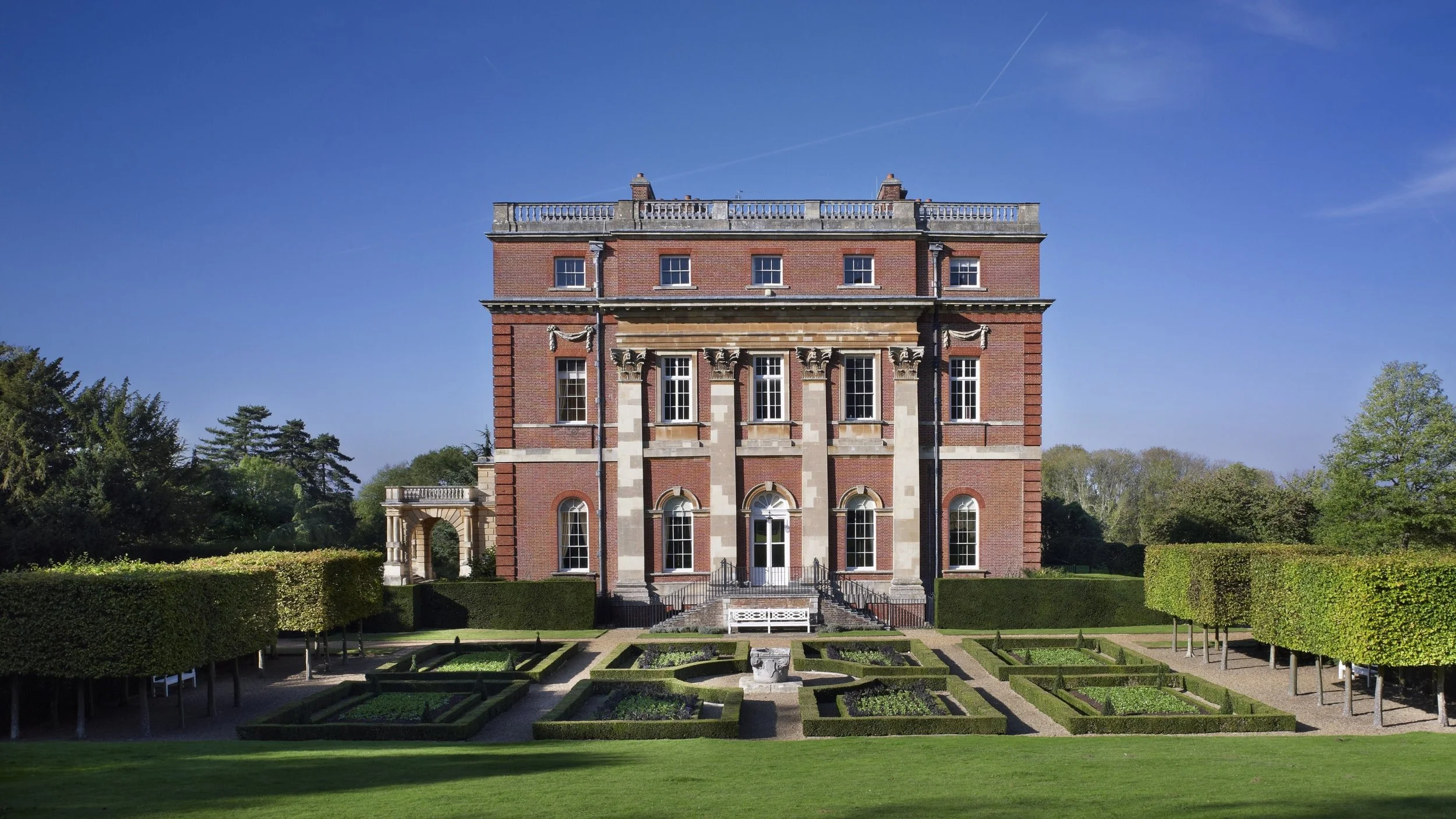
Clandon Park was built in the 1730s for the influential Onslow family and designed by the Venetian architect Giacomo Leoni, one of the leading figures responsible for bringing Palladian architecture to Britain. Inspired by the work of the sixteenth-century architect Andrea Palladio, Leoni created a house that looked towards continental Europe as much as it did the English countryside.
Unlike many country houses of its date, all four façades were designed to be seen. There was no plain rear elevation hidden from visitors. Like the Italian villas that inspired it, Clandon was intended to be admired from every angle, standing proudly within a landscape that would later be shaped in part by Lancelot ‘Capability’ Brown (what a name), an eighteenth century landscaper who designed over 170 landscapes and estates in England, including that of the iconic Blenheim Palace in Oxfordshire.
If the architecture established Clandon’s reputation, it was the interiors that secured it. Visitors came to see the extraordinary Marble Hall and the richly decorated state rooms, where elaborate plasterwork by the Italian stuccatori (master decorative plasterers) Giuseppe Artari and Giovanni Bagutti (now try saying that five times fast) transformed ceilings into works of art. Marble chimneypieces by the Flemish sculptor John Rysbrack, intricate panelling and painted finishes combined to create one of the country’s most important eighteenth-century interiors.
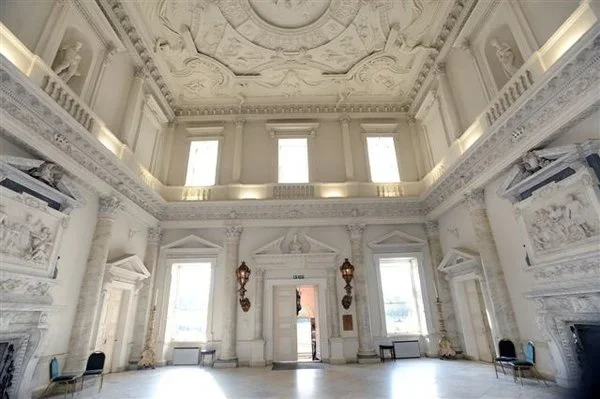
Clandon’s Marble Hall before the fire …
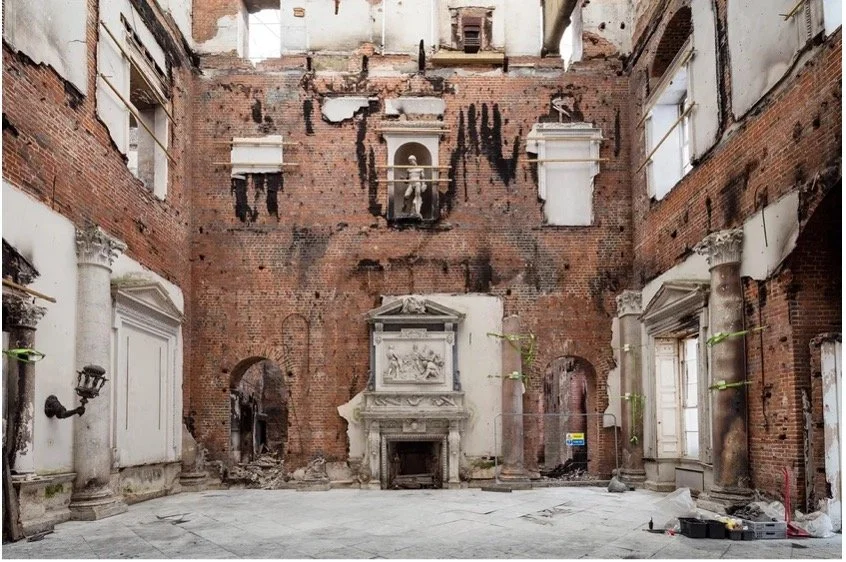
… and after
Clandon (used in 2008 in The Duchess, starring Keira Knightly) belonged to an absolutely remarkable generation of English country houses, built alongside places such as Houghton Hall in Norfolk, and Lyme Park in Cheshire (used itself in the BBC’s 1995 adaption of Pride and Prejudice), where architecture and craftsmanship came together to express wealth and ambition on an extraordinary scale.
Yet even before the fire, Clandon was much more than a showpiece of Georgian design. The property had been a family home for the Onslows for more than three centuries before passing to the National Trust in the mid-twentieth century. During the First World War it became a place of recuperation for injured soldiers. During the Second World War, some of the nation’s most important historical records were stored there for safekeeping by the Public Record Office.
Since opening to visitors in 1958, thousands of people have passed through its rooms for entirely different reasons: to admire the architecture, to attend concerts and weddings, to volunteer, to work, or simply to spend an afternoon with family.
The fire felt like such a loss because it wasn’t only the destruction of historic items and rooms, although that was pretty bad too. It was the loss of a place that had accumulated nearly three hundred years of memories and meaning. The instinct to rebuild it exactly as it had been was understandable.
But as conservation teams began to assess what remained, another interesting possibility emerged. The fire had destroyed much of what visitors once admired, yet it had also revealed something that had been hidden for centuries. Beneath the decorative finishes lay the structure of the house itself: its brickwork, its methods of construction, traces of earlier alterations, fragments of craftsmanship and evidence of the countless decisions that had shaped it over generations. Clandon was no longer simply a masterpiece of Georgian decoration. It had become something actually much rarer.
A building capable of showing its own story. If walls could talk and all that…
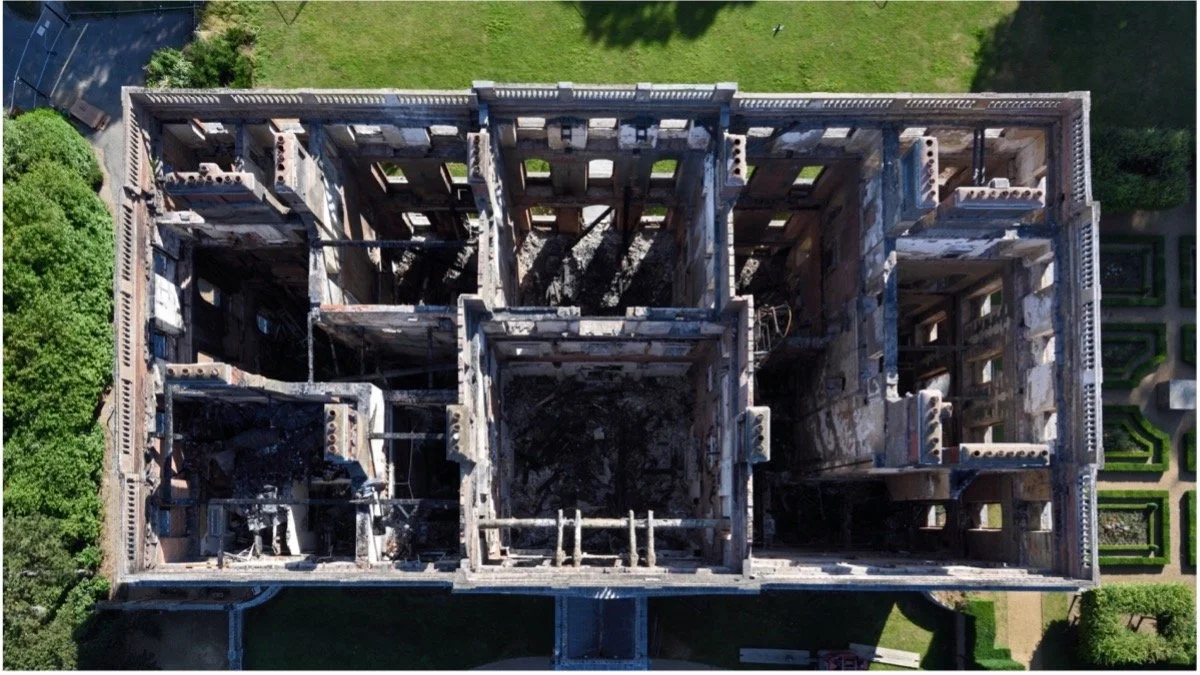
Aerial view of Clandon after the fire
With that discovery, the challenge facing its custodians became infinitely more complicated than simply putting the pieces back together.
The response that developed has been described in terms of ‘conservation and renewal’, a juxtaposition if I ever heard one. From the outside, the intention is to restore the familiar image of Clandon Park as it existed before the fire, repairing the brick and stone shell, reinstating windows and doors, and ensuring that the building continues to look like a complete Georgian house within its landscape. It preserves the way the house sits in relation to those gardens designed by Capability Brown, and it maintains the visual presence that has defined Clandon for centuries.
Inside, though, the approach is the complete opposite. Rather than attempting to recreate what was lost, the surviving fabric is being conserved and carefully re-presented in its fire-altered state. The exposed structure is not being hidden again behind reconstruction, but treated as part of the building’s ongoing history.
New walkways, stairs and lifts are being introduced to allow free movement through the shell, creating views between spaces that would never previously have been possible. What were once enclosed rooms are now interconnected, revealing the scale and construction of an eighteenth-century country house in a way that would otherwise have remained concealed.
This decision to preserve the post-fire interior rather than erase it is not simply aesthetic, it reflects a particular understanding of what gives a building its significance. Clandon is important not only because of its completed Georgian interiors, but because of what those interiors were made from and how they were constructed. By leaving elements of the fire damage visible, the conservation strategy allows the building to continue acting as evidence.
It shows, quite literally, how such houses were built: the brick core beneath the plaster, the timber laths supporting decorative finishes, the traces of earlier structures incorporated into later ones.
Spaces are being created for exhibitions, interpretation and social use, allowing the building to function once more as a site of gathering and engagement. In this sense, renewal does not mean returning to a previous state, but finding a new way for the building to remain meaningful.
A more straightforward restoration might have attempted to return Clandon to its pre-2015 condition, creating an illusion of continuity. Another approach might have accepted the fire damage as terminal, preserving the house as a permanent ruin. Instead, the chosen path sits between those positions, acknowledging loss while refusing to let it define the building entirely.
For anyone who cares for old houses, even on a far smaller scale, this kind of balancing act may feel familiar. Very few decisions in the life of a historic building are clear-cut. A replacement window might be more aesthetic, but less authentic. A plaster ceiling might retain its character but be concealing structural weakness. A removed partition might open up space but erase evidence of how the building once functioned. The question is rarely what is technically possible, but what kind of story the building will carry forward as a result.
Clandon simply makes that dilemma more visible. The scale of loss has forced every intervention to be considered not just in terms of repair, but in terms of meaning.
What should be returned to how it was, and what should be allowed to remain as it is now? What does it mean to treat damage as part of a building’s history rather than an interruption of it?
There is no single answer to those questions, and this Clandon project does not pretend there is. It accepts that custodianship involves judgement that cannot always be solved in advance.
What Clandon makes clear is that custodianship is rarely about choosing between right and wrong outcomes. It is about working with conditions that are already imperfect, and making decisions that will themselves become part of the building’s history. Even the most carefully considered intervention changes what a house is. The question is whether that change clarifies or obscures what matters about it.
Most people will never be responsible for a building on the scale of Clandon Park, but the underlying challenge is not so different from the ones that appear in smaller ways: whether to repair or replace, whether to preserve or open up, whether to prioritise convenience or character.
Each decision leaves a trace, and over time those traces accumulate into the version of the house that future custodians inherit.
Clandon shows that looking after an old building is not an act of preservation in the strict sense, but an ongoing negotiation with time and change. And it suggests that the most careful custodians are not the ones who try to freeze a house in its best-known moment, but the ones who accept that every choice they make is part of what the house will eventually become.
What is your take on the responsibility of custodianship, and the National Trust’s decision not to rebuild Clandon Park? Do you have a historic home which has asked similar questions of you? Let us know in the comments, or drop us a message.
Read about the 8th Earl of Onslow’s (quite surprising) take on the matter here.
Built to Last explores the materials, craftsmanship and stewardship that allow old houses to endure. Through essays rooted in real buildings and real people, it asks what survival can teach us about longevity, repair and care.
Our journal, Built to Last, asks the question ‘What does it mean to be a good custodian?’ Through essays, conversations and stories rooted in real buildings and the people who care for them, we explore what it takes to preserve an old home’s fabric and its story - and the decisions that shape both.
At Pursuing the Past, we research and write beautifully presented House Stories, turning historical detail into lasting pieces of storytelling that deepen your connection to your home and invite you to take your place as custodian of its continuing story.