The Comprehensive House Story
For period homes with a well-documented story
For medium to large Georgian or Victorian cottages, medium-sized detached Georgian, Victorian or Edwardian houses, and substantial Victorian or Edwardian semi-detached homes. Tudor, medieval and other pre-Georgian homes are particularly well suited to this level, where the depth of research required to piece together centuries of history is matched by the time and expertise we invest. These are often characterful period properties found on village lanes, in established suburbs, or in historic towns and neighbourhoods.
These are the kinds of homes that often appear in a broad range of surviving records, even if they were not especially grand or architect-designed. Depending on the property, we may draw on census returns, historic maps, street directories, electoral registers, newspaper archives, valuation surveys, tithe records, wills, estate papers, land tax records, rate books, photographs and more - depending on what has survived.
The result is a richly detailed house history that is both personal and well contextualised, revealing the stories of the people who lived there, how the house changed over time, how the surrounding area developed, and the wider social history your home has witnessed.
Twenty five hours of historical research, undertaken both online and in physical archives
Detailed consultation of 30–40 historical sources
Analysis, transcription and full professional referencing throughout
A 6,000-word narrative written by a professional heritage writer
Two professionally edited and beautifully designed softback books, presenting your home’s full story alongside carefully selected images
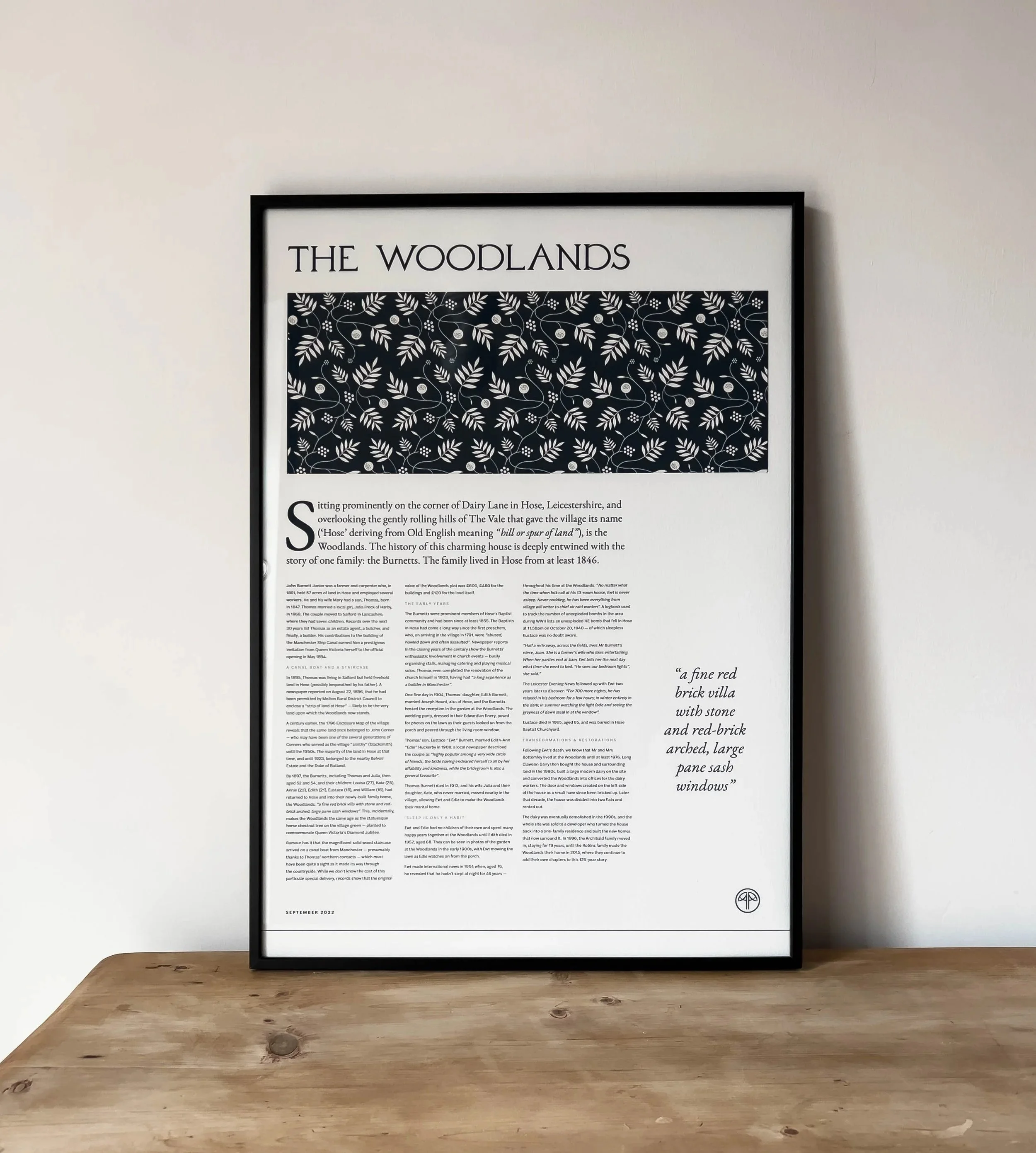
An A2 fine art print of your home’s story, produced in your chosen style
A digital copy of your storybook, together with a complete digital research portfolio containing the full body of discoveries
Estimated turnaround: 10–12 weeks, depending on our schedule at the time of booking. This will be confirmed during the booking process.
Investment: £3,000
Payment: Either in full or over two monthly instalments
‘You uncovered so many little gems about our beautiful house that may otherwise have been lost or overlooked. The communication was fantastic throughout and the finished book was beautiful, so incredibly detailed.’
VICTORIA, MEAGRAM HOUSE - THE CLASSIC
‘It really resonated when I read about George Stratton, the longest resident at Stoneheal Cottage, and that he was a gardener, as I work in horticulture and actually own my own nursery. It makes me wonder if George Stratton is still here, keeping an eye on the place. Thank you for all the hard work that has gone into bringing the history of Stoneheal Cottage to us.’
SUZIE, STONEHEAL COTTAGE - THE CLASSIC
FAQs
-
We trace ownership and occupancy chronologically as far back as surviving records allow, uncovering as many individuals and families as possible within the scope of your chosen package. The level of detail available can vary from one property to another, depending on which records have survived and how fully a house and its residents were documented over time.
Please note that information on occupants and owners after the 1939 Register can be more limited, as privacy laws restrict access to more recent national records.
-
In over 90% of cases, we find sufficient surviving records to create a meaningful and well-evidenced house history.
Once you commission a House Story, the first step is a feasibility assessment. If we find that there are not enough surviving records to support the story level you have chosen, we will recommend a more suitable option and refund the difference. If we find that your house cannot be identified clearly enough in the surviving records to support even our smallest House Story, we will issue a full refund.
In some cases, a property may not be easily identifiable in the records available at this stage. That does not necessarily mean that no records exist, but rather that we cannot confidently guarantee the level of evidence needed to complete one of our House Stories without further research time. Where appropriate, we will advise on possible next steps, including speculative research in local archive collections to see whether a breakthrough can be made.
If you would prefer to establish this in advance, you can book a consultation first. This helps determine whether your property is suitable for one of our House Stories, and which story level is likely to be the best fit.
-
Yes. We are very happy to incorporate relevant records and research already in your possession.
Any original documents or materials you provide will still need to be reviewed, transcribed and fully referenced as part of the process. If the amount is modest, this can often be covered within the research time included in your chosen House Story. If more substantial work is required, we may recommend adding additional research time. We can advise on this either before or after booking.
The same applies to any research you have already undertaken yourself. We will need to verify, transcribe and reference it properly before it can be included, and depending on the volume and complexity, this may either fall within the included research time or require additional hours.
If you have any questions, please email us at support@pursuingthepast.co.uk.
-
Yes. If you decide you would like a more in-depth House Story, you can upgrade at any stage by paying the difference between the two story levels.
-
In around half of our house histories, we are able to identify a precise build date, although this depends very much on the age, status and surviving records of the property.
For Victorian and Edwardian houses, even where an exact date does not come to light, we can often narrow the construction period using sources such as historic maps and other contemporary records. For older properties, archive research is needed to establish a likely date range, and in some cases it may only be possible to suggest a period rather than a single year.
Details such as the architect or builder are more likely to emerge for larger or more notable houses, but as with all house history research, it depends on what records survive for your particular property.
-
Historical photographs are relatively rare, but always a particularly exciting discovery when they do emerge. We find them for around 5–10% of properties.
They are more likely to survive for larger or more prominent houses, but they do occasionally surface for more modest homes too. As ever, it depends on what records survive for your particular property.
-
Yes, wherever the evidence allows. While the main focus of our work is the social history of a house - the people who lived there, how it was used, and how it changed over time - we also include details of the building’s architecture and development whenever these emerge through the research.
Before we begin, we will ask you to share anything you already know about the property, including its age, alterations or architectural features. This can be extremely helpful in guiding the research and building a fuller understanding of the house and its history.
-
Our work is now focused primarily on houses built before 1920.
This is because our House Stories are designed to offer a richly documented and well-evidenced account of a property’s past. For houses built after 1920, the surviving material is often more limited, and many of the records that help us trace individual occupants remain closed for up to 100 years after birth. As a result, we are not usually able to guarantee the depth of evidence needed for one of our standard House Stories.
There may occasionally be exceptions for houses of particular architectural significance, especially where a property was well documented from the outset. If you are unsure whether your house may be suitable, you are very welcome to get in touch and we can advise.
-
Online records can take us a long way, and many valuable sources are available digitally, including census returns, historic maps, newspapers and directories.
That said, the fullest account of a house’s history often depends on material that is only available in local and national archives. Records such as deeds, tax records, wills and probate material, sales particulars, estate papers and manorial documents can add important depth and detail that is not accessible online.
Because of this, all of our House Stories now include both online and archive research, allowing us to build as full and well-evidenced a picture of your home’s past as possible.


‘I have always loved this house - even before moving in I used to spot it as I drove past. Now knowing it was the village Surgery for many years (as a nurse) I feel I now understand that draw better. The rich and colourful lives of the people who lived here was incredible. Learning that the road and houses behind us had once been our orchard was a surprise. The wall print is now proudly hung in our hallway.’
AMANDA SCOTT, FARBROOKE HOUSE, LINCOLNSHIRE - THE CLASSIC